-
![]()
Build a unique character!
-
![]()
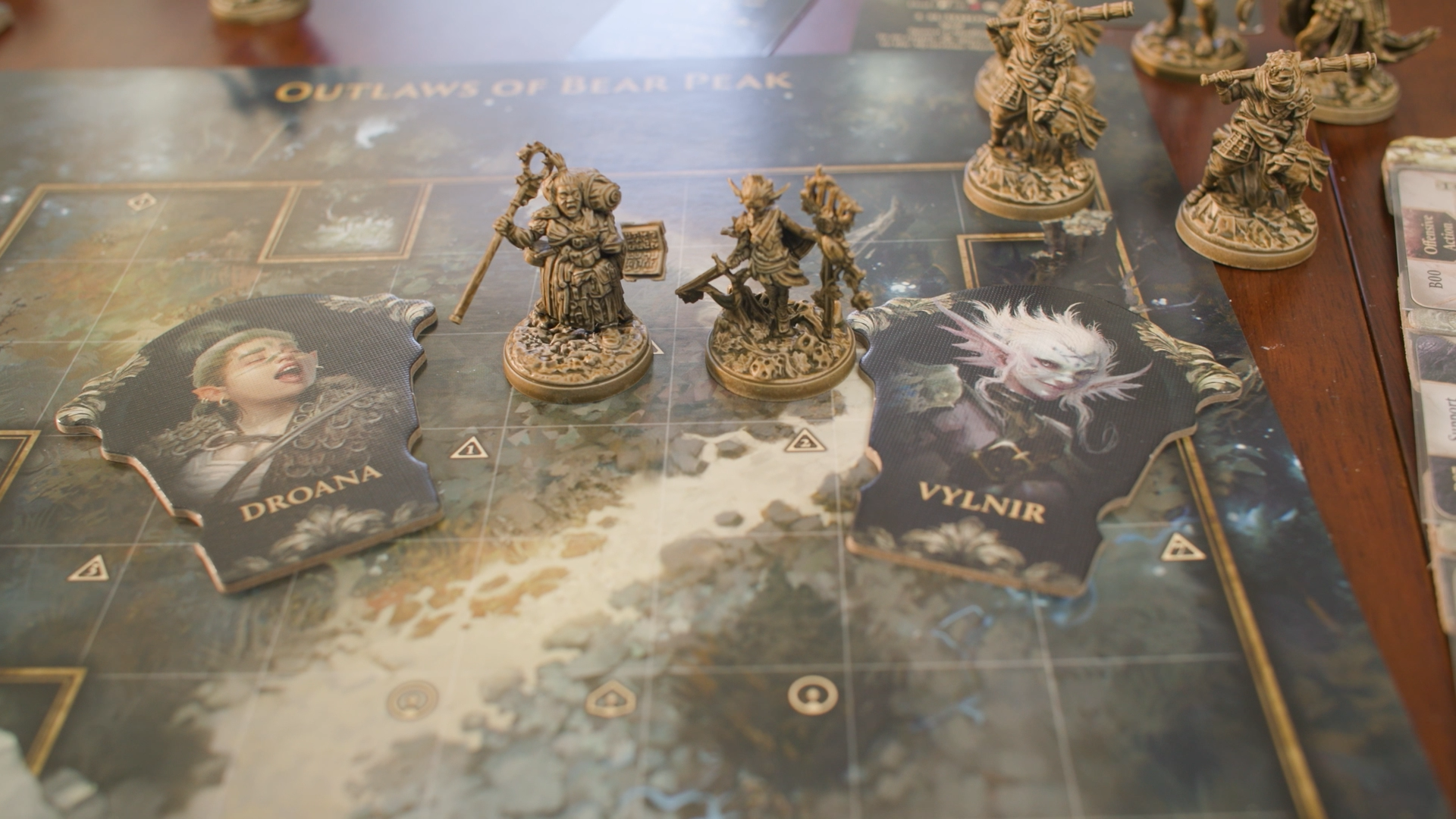
Recruit mighty companions!
-
![]()
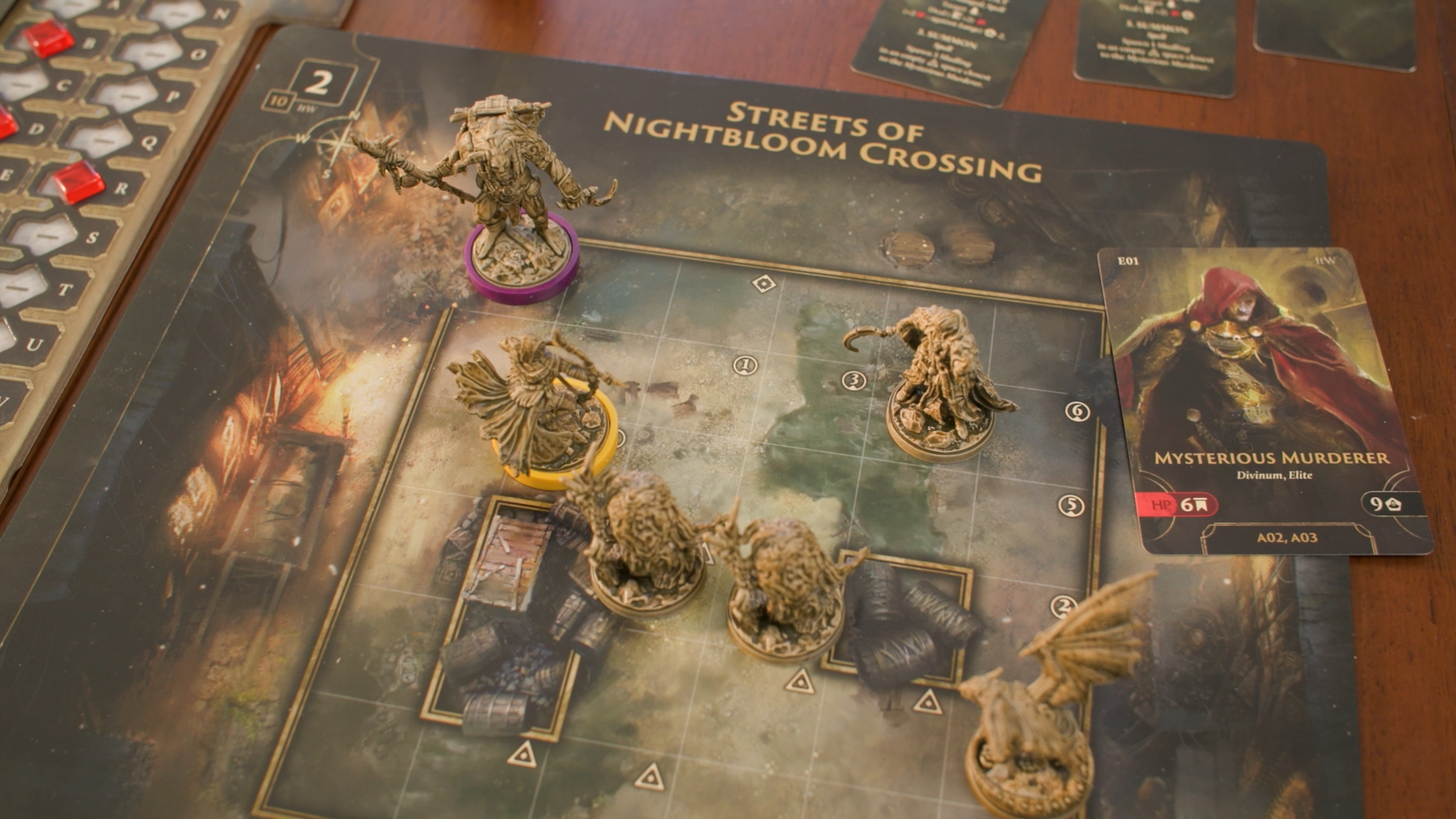
Battle legions of incredible enemies!
The Story
Player count: 1-5, lower is recommended
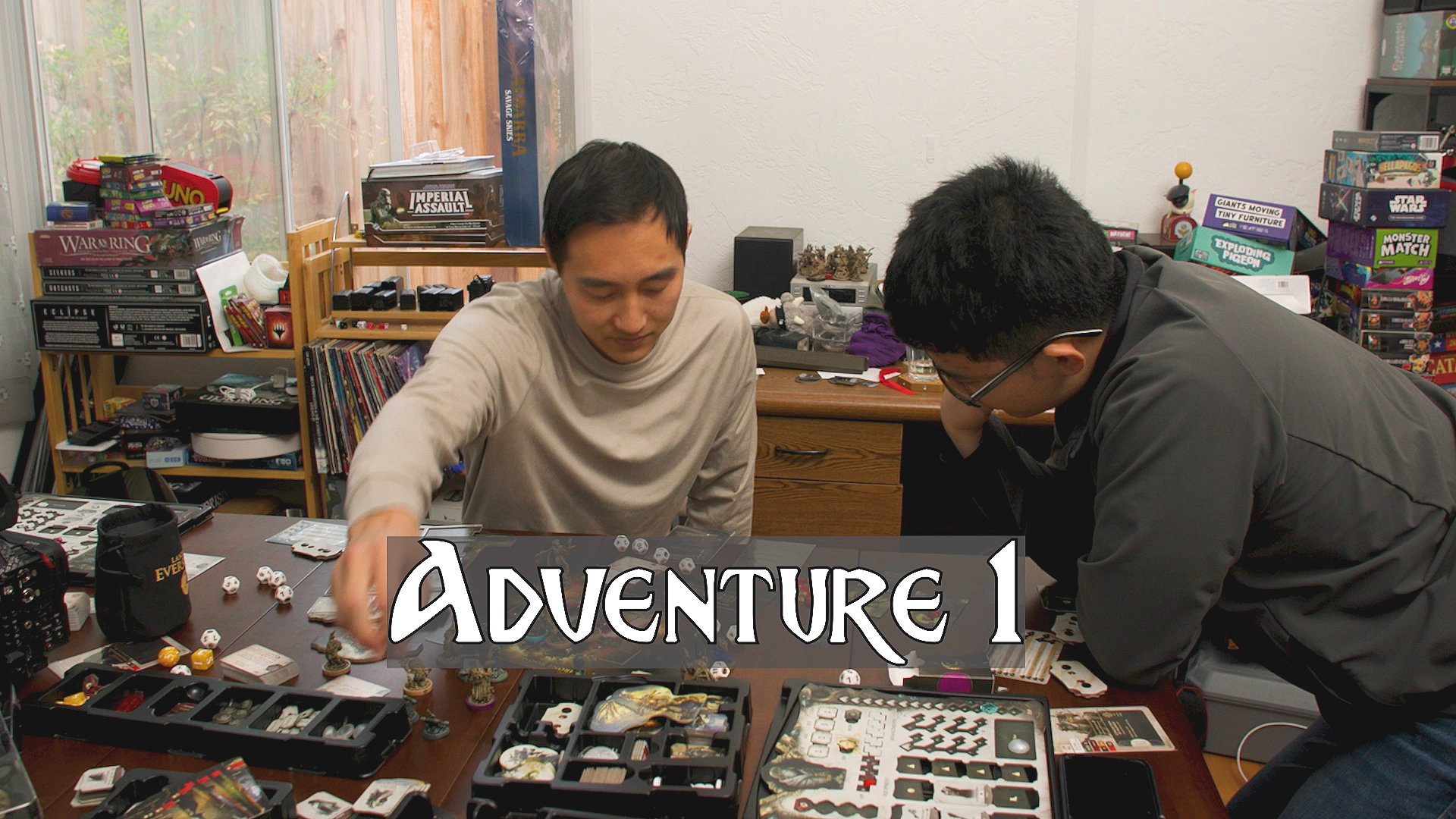
Play time: roughly 1.5-4 hours per chapter, with a full adventure running around 15-18 hours.
Played: First two adventures (2p and solo)
Spoiler Note
This review won’t show any components that are not explicitly from the beginning of adventure 1.
But this review is written from the perspective of someone who has completed the story of adventure’s 1 and 2, just without specifics.
Need to learn how to play? Or want more reasoning for our points? Our review video’s got you!
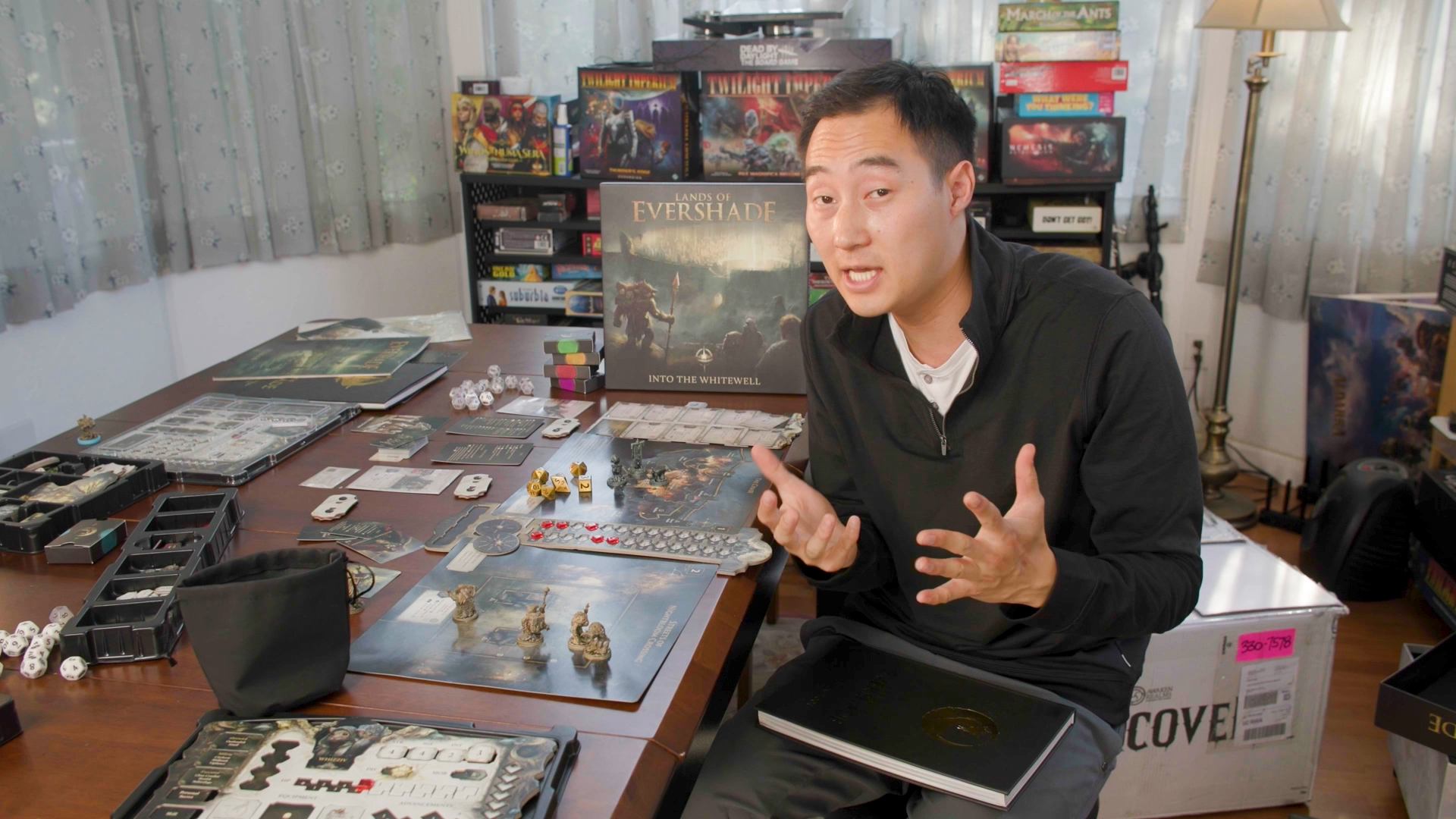
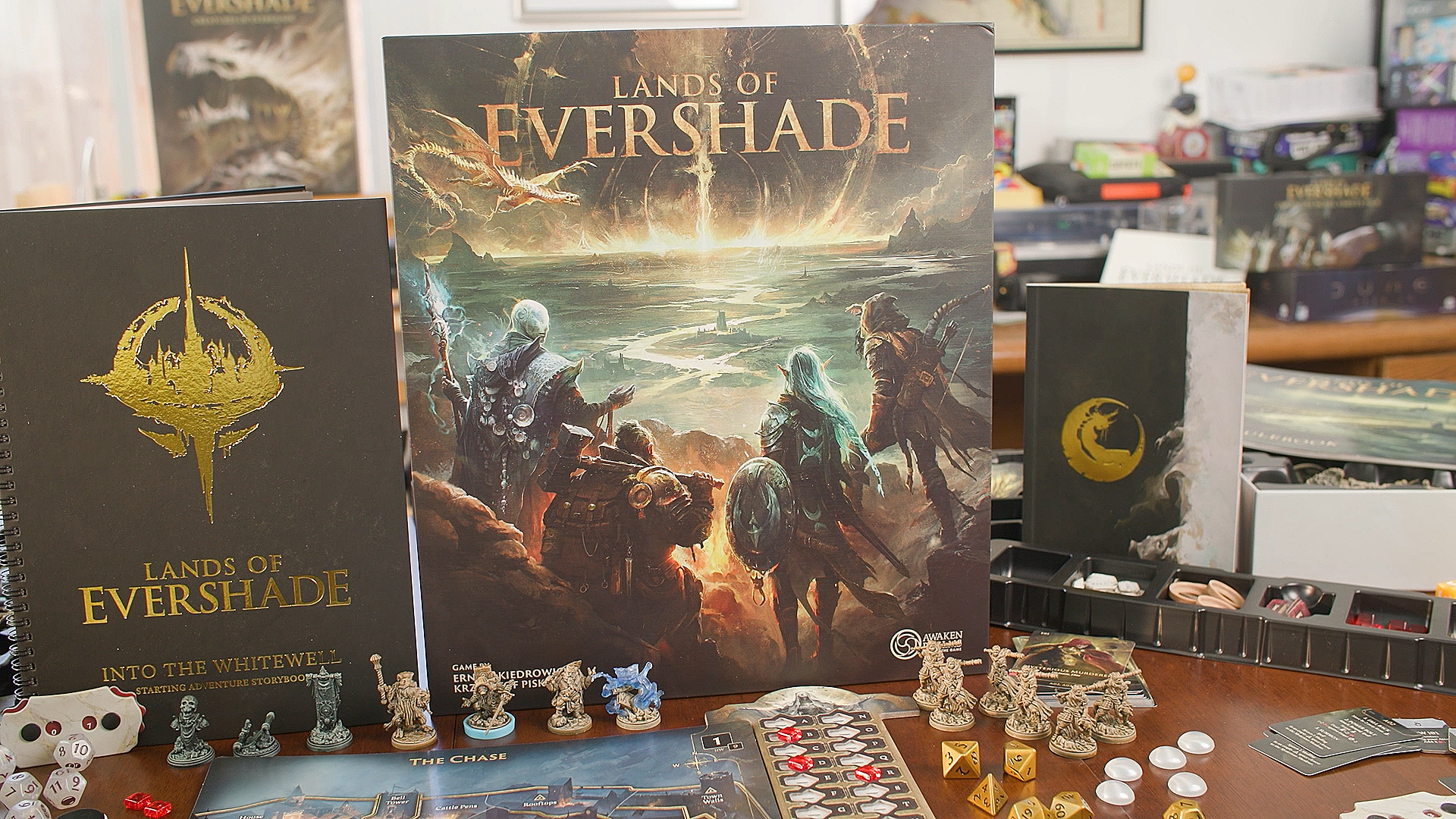
Component Pros - Strong Storage and Organization
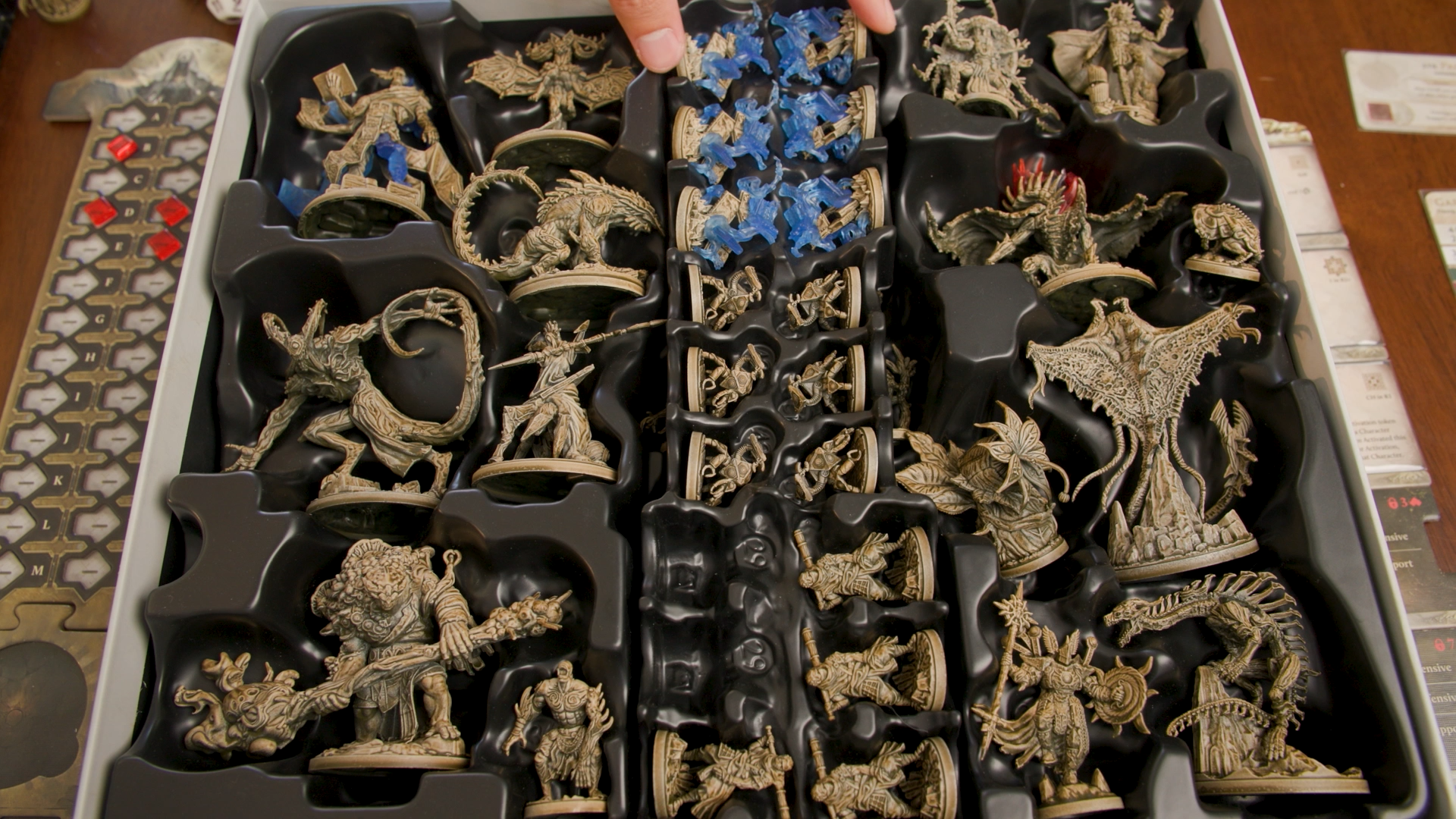
The miniature organization is very helpful for a campaign game this large.
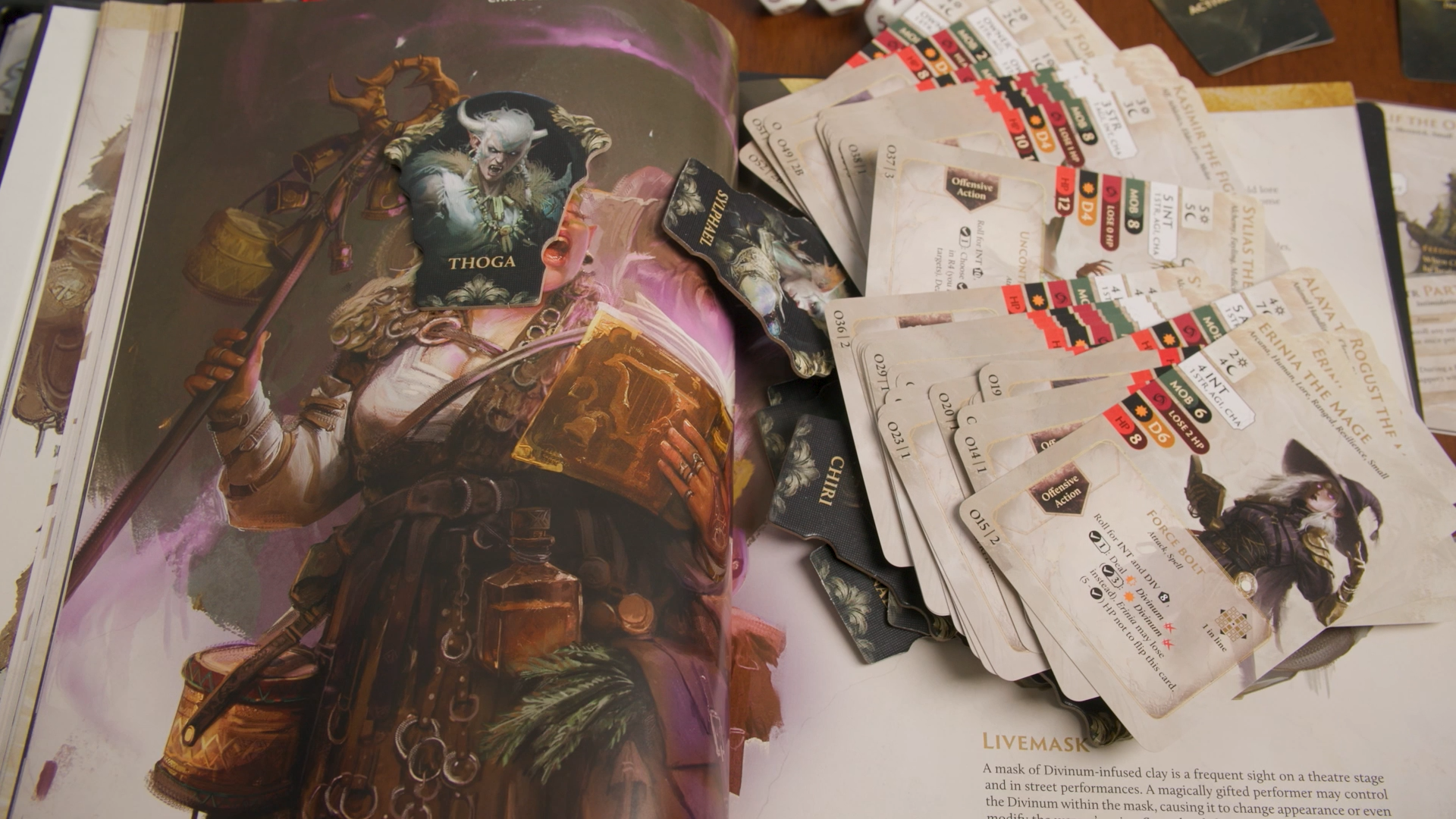
Playable characters, monsters, and map minis all have designated homes.
Minis are numbered, and the insert spaces match those numbers.
This makes cleanup much easier after long sessions.
The adventure boxes are a smart inclusion because each adventure’s components stay separated.
Setup and teardown are surprisingly fast for a game with this many parts, often around 5–10 minutes once organized.
No plastic bags are really needed, which is a major win for a huge campaign box.
Component Pros - Player Boards, Cards, and Dice
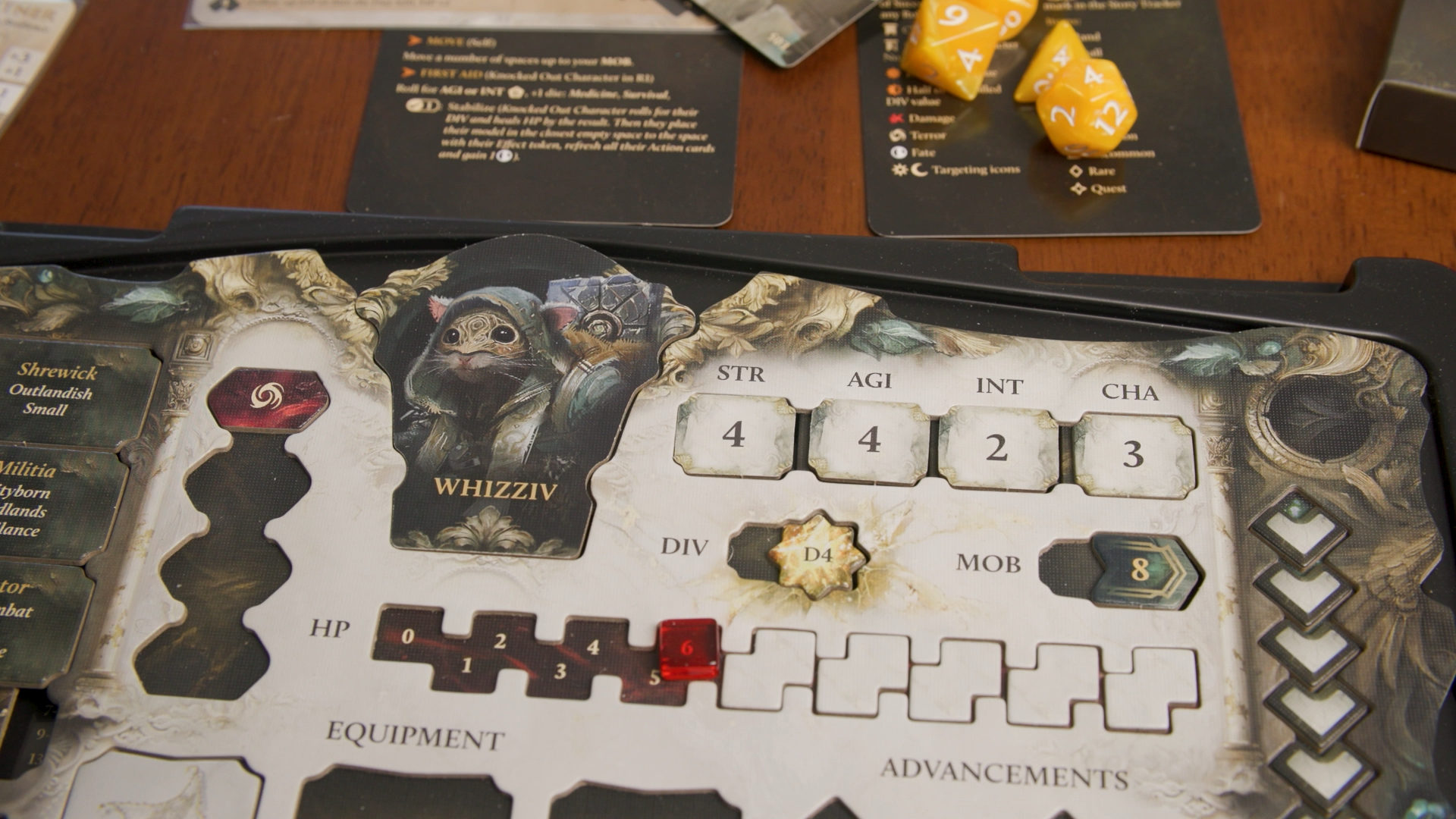
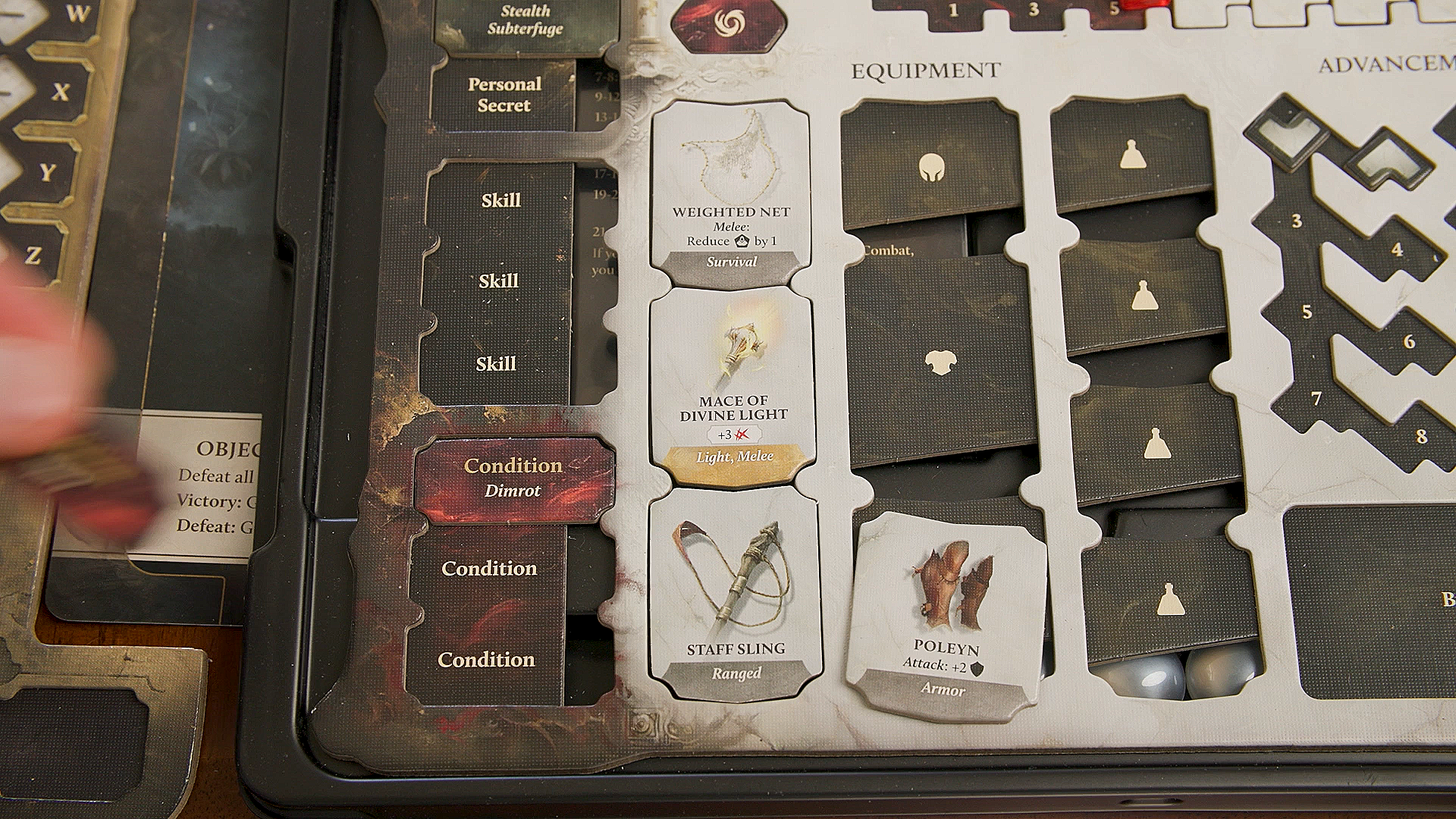
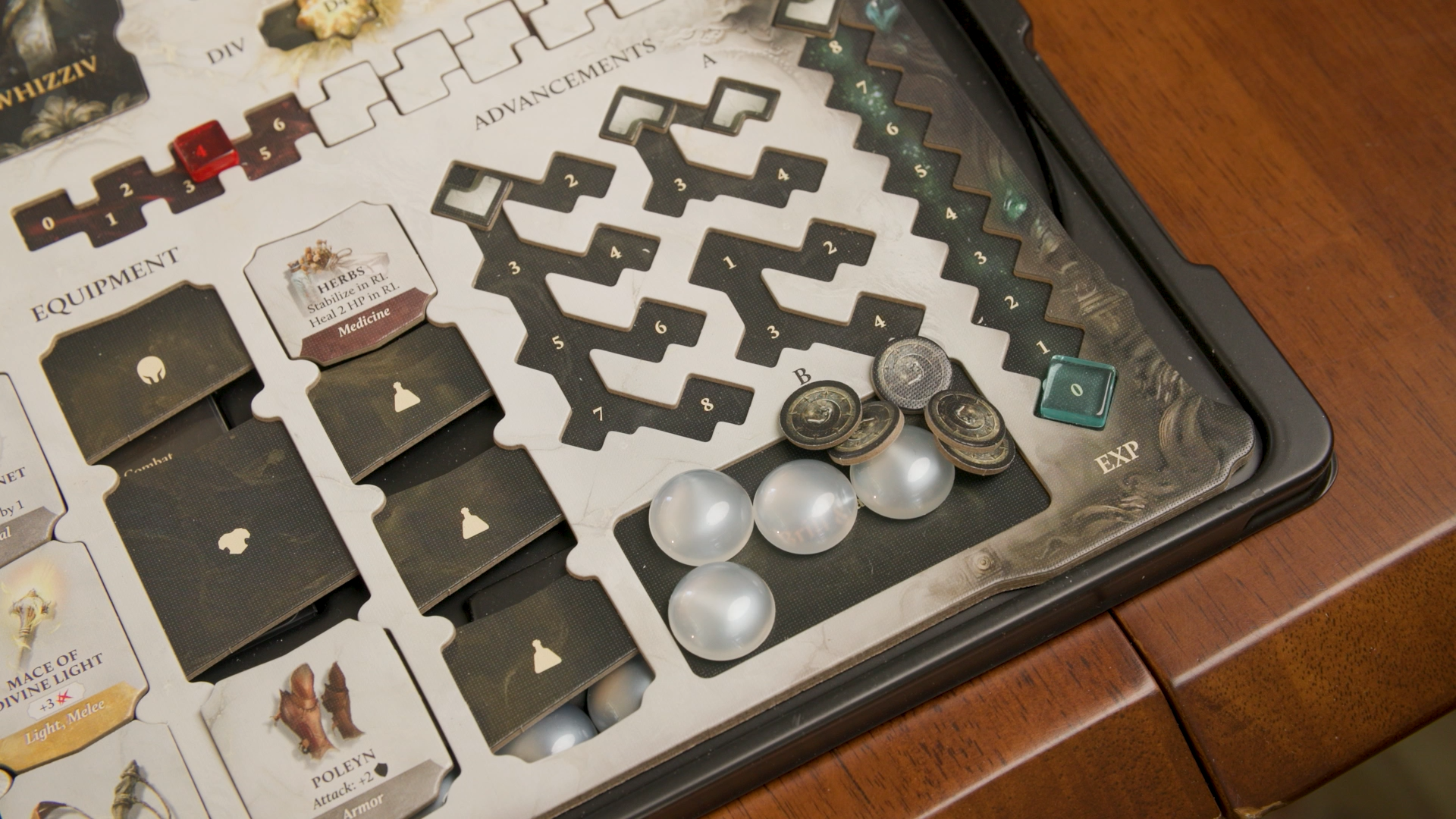
The player boards are cleanly structured and easy to use.
Items slot nicely into the boards and clearly show whether they are one-time-use effects or passive bonuses.
Fate tokens sit in a useful indented tray.
Player boards stack cleanly between sessions, helping preserve each character’s setup.
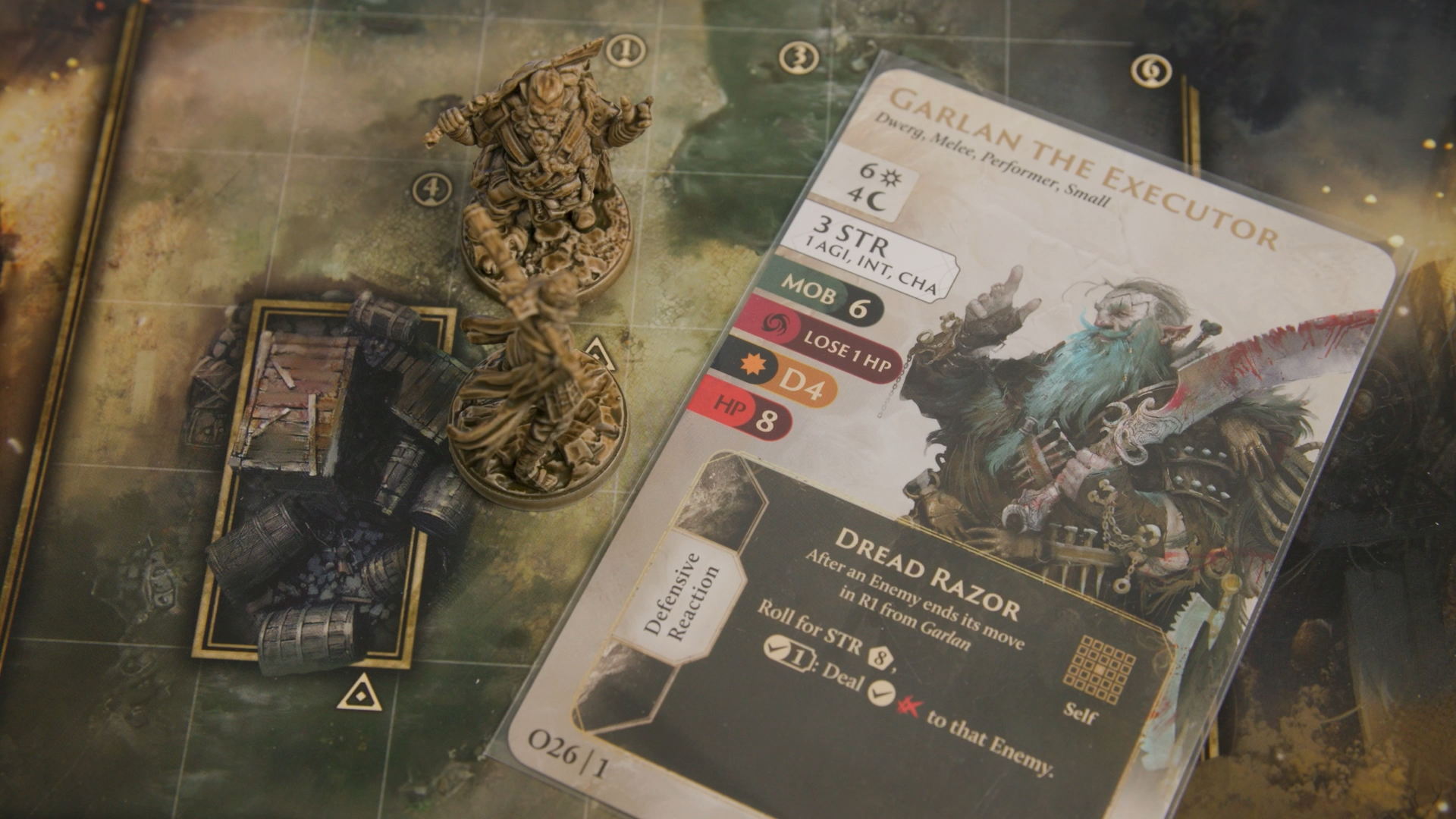
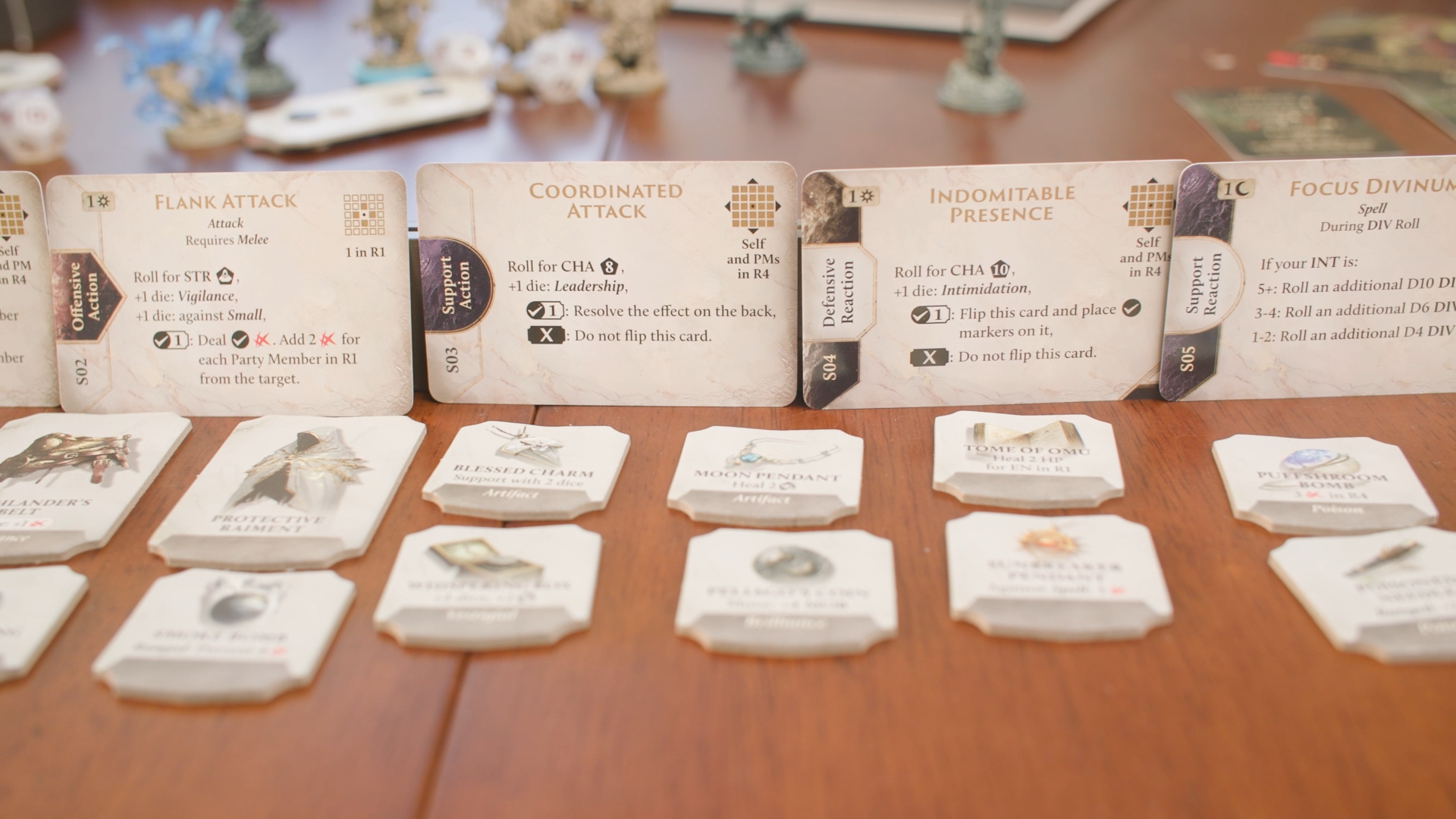
Combat ability cards are small, but that works well because they do not take up too much table space.
Turning used combat cards over is an intuitive way to show what has been spent.
The pouch system is simple but useful, keeping unused or saved character materials out of sight until camp or rest phases.
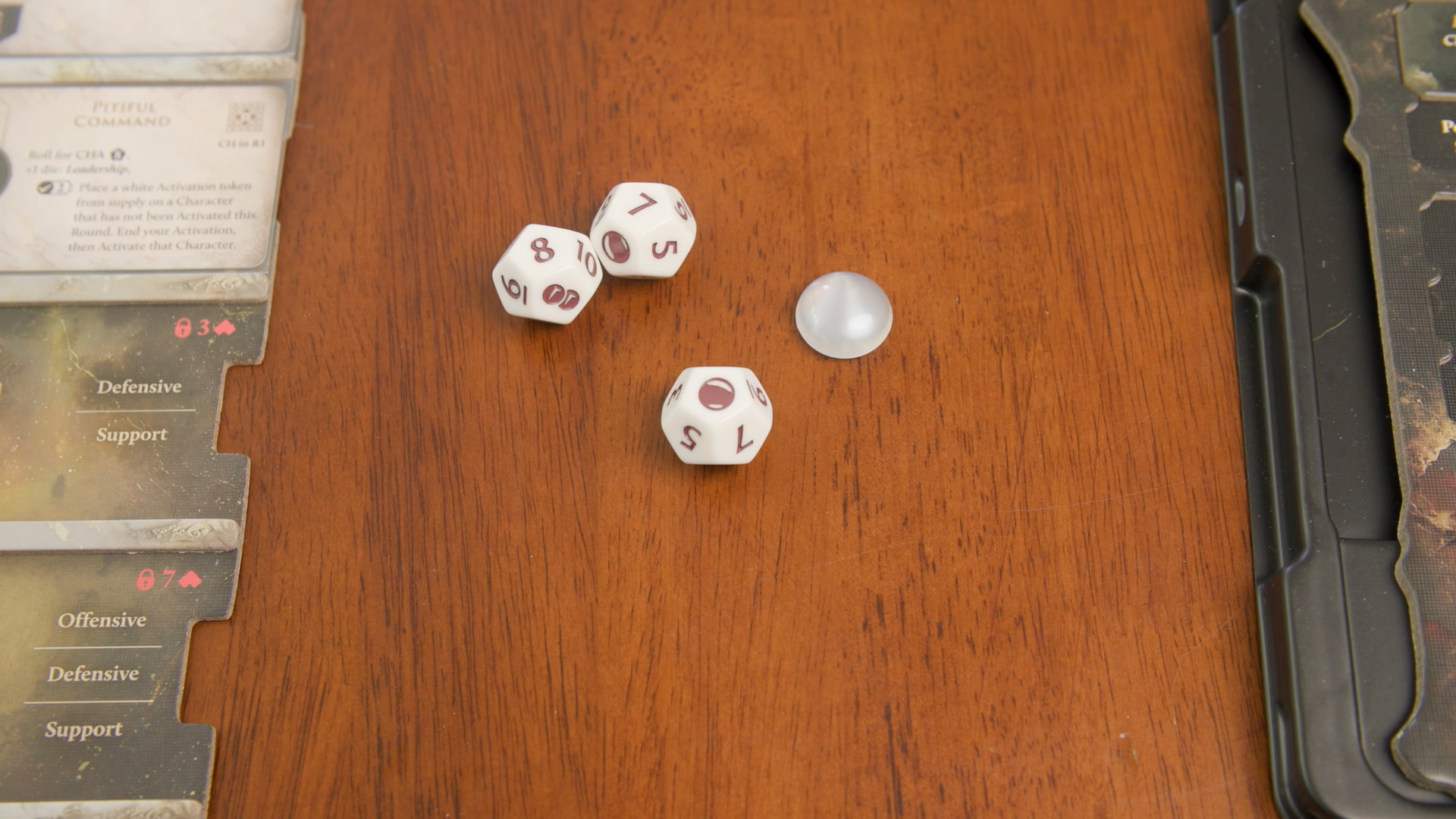
D12s feel excellent to roll, the special fate symbol is easy to recognize and getting a natural 12 feels exciting immediately (double success).
Fate stones feel thematically correct because they represent altering your luck.
The story tracker frames the secret sheets well and keeps the campaign organized.
The rotating time token is a small but satisfying way to creature pressure.
The marker system is cleaner than traditional ttrpgs, even if players may still want to take notes.
Component Pros - Art, Handbook, and World Presentation
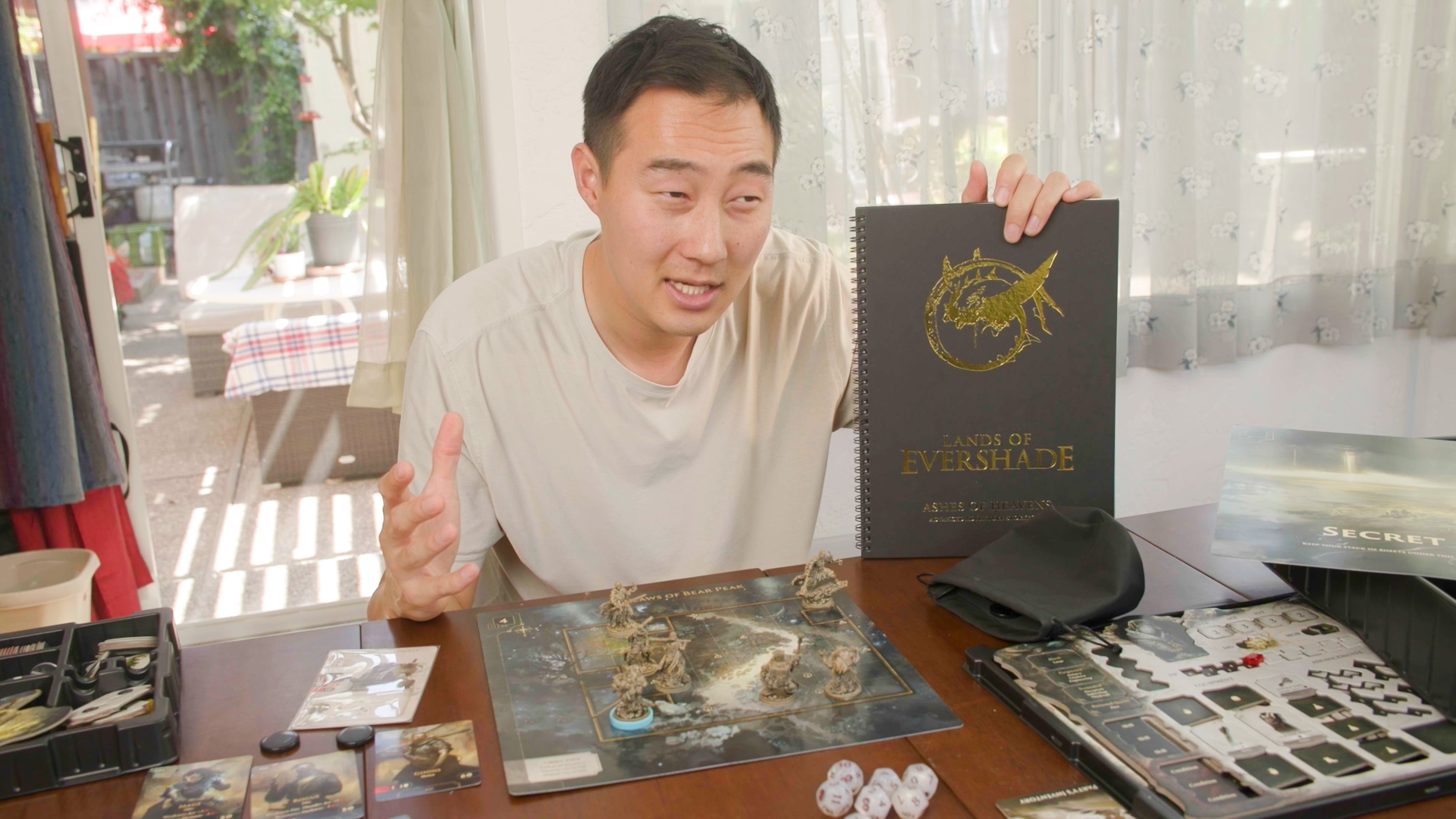
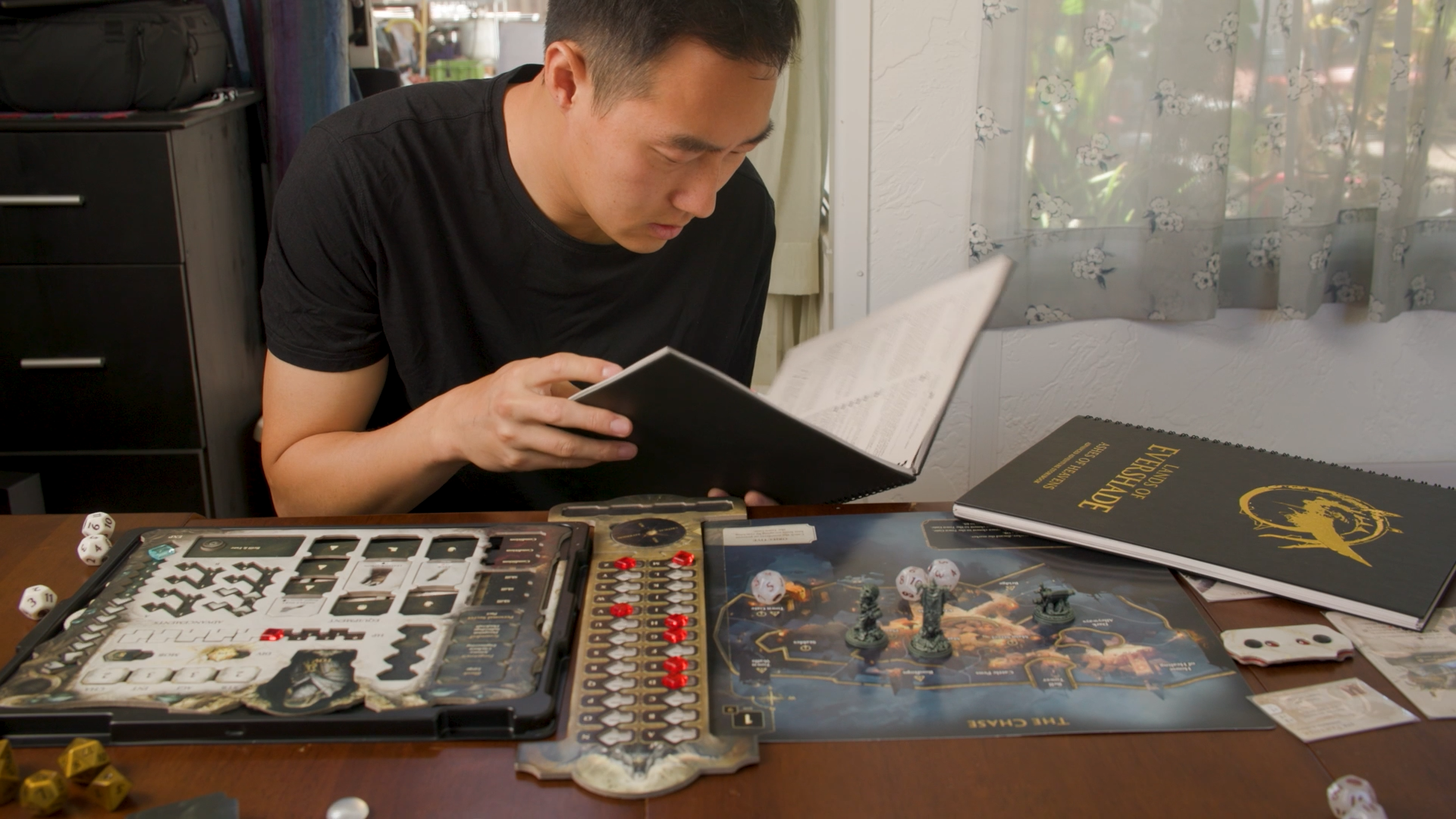
The hardcover player handbook feels like a proper RPG book.
It’s full of races, classes, religions, landscapes, and worldbuilding.
The game includes a huge amount of art across maps, items, characters, enemies, and story moments.
The overworld sheets do a great job of pulling players into the setting.
Cities, wilderness, churches, mountains, shops, and strange structures are supported by both art and flavor text.
Item art is especially satisfying because board game RPG items feel more tangible than simply writing equipment on a character sheet.
The parchment-style world maps are a great touch for the whole party.
Component Pros - Production That Earns it’s Table Space
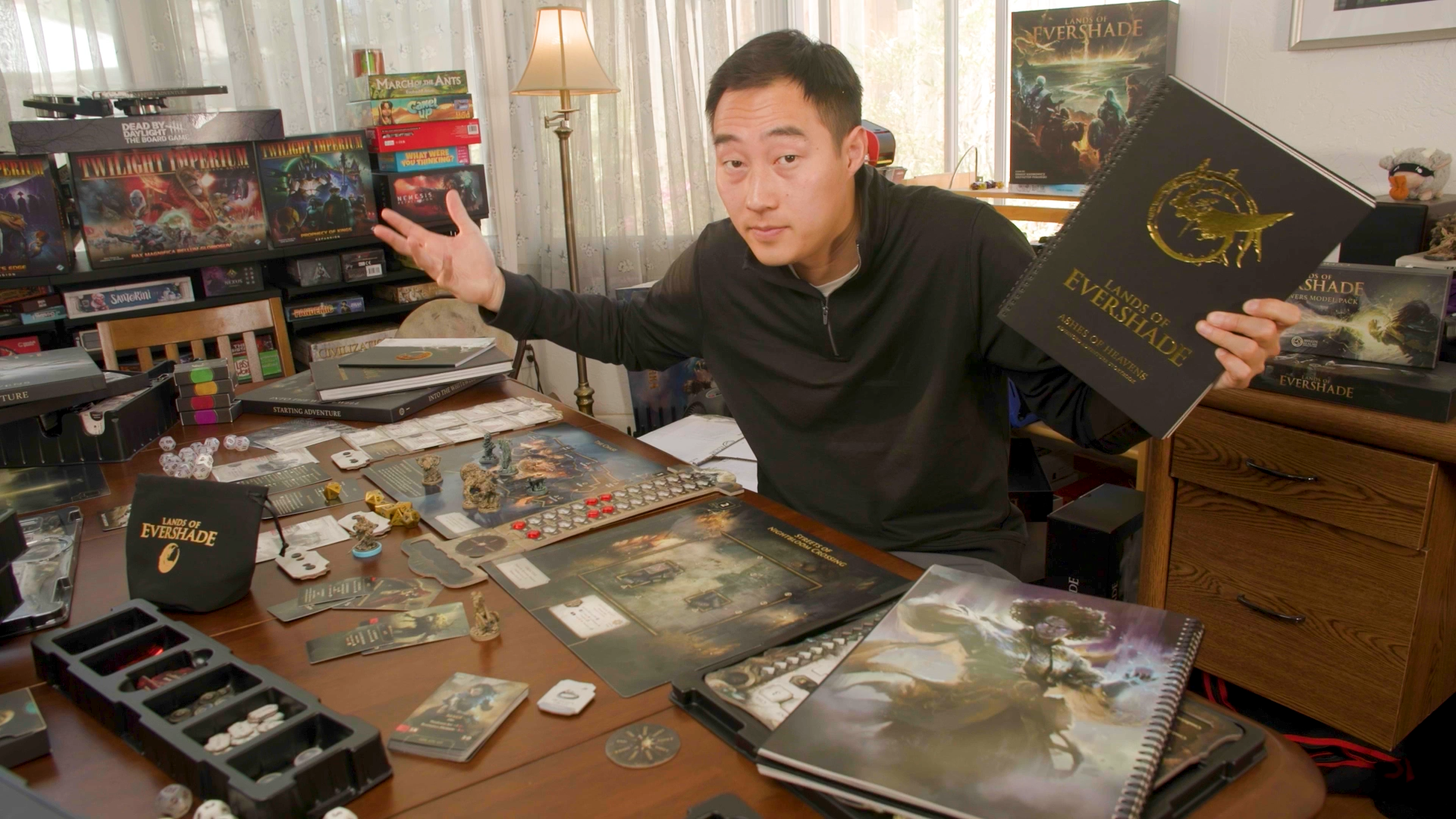
The game is enormous, but the space does not feel wasted.
The overall production is gorgeous, with a gritty fantasy style that fits Awaken Realms’ usual strengths.
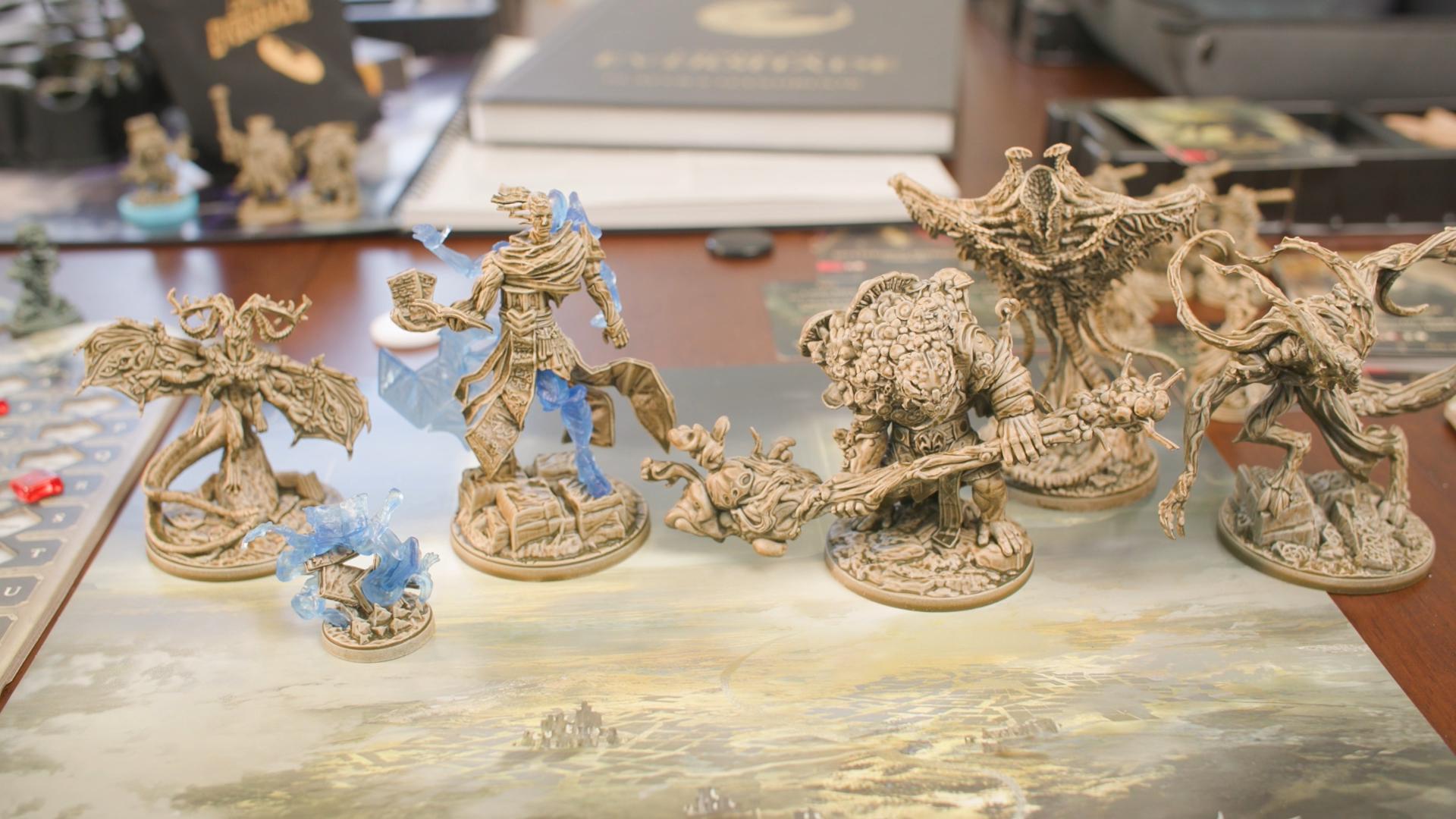
The miniatures are excellent and may be among Awaken Realms’ best.
No broken miniatures appeared after unboxing, which is impressive for a game of this size.
The party marker is easy to grab and satisfying to move around the map.
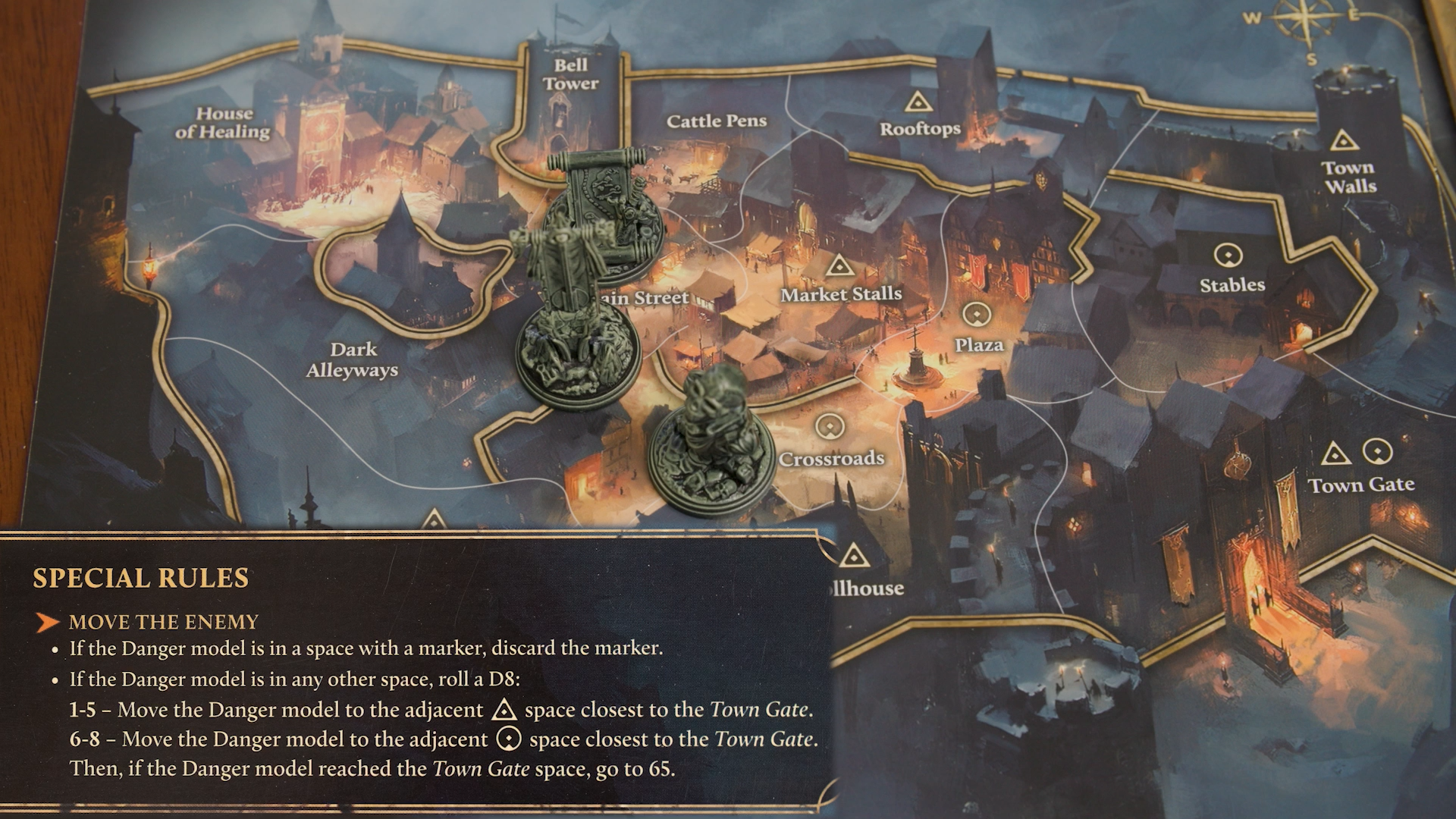
Quest and danger markers are visually clear, especially the large skull danger marker.
Character bases have soft rubber bottoms that grip the sheets well.
Gameplay Pros - Choose-Your-Own-Adventure Gameplay
The storybook is the heart of the game. Choices often matter later, even when they seem small at the time.
The writing balances exposition with action well.
Instead of long stretches of passive reading, the game frequently asks players to make choices, check story markers, roll dice, or respond to the situation.
The world feels larger than the actual paths available because the game often shows possibilities you cannot access yet.
Race, class, items, and story markers can unlock unique passages.
This makes character choices feel integrated into the world rather than just being stat differences.
Gameplay Pros - Worldbuilding That Actually Matters
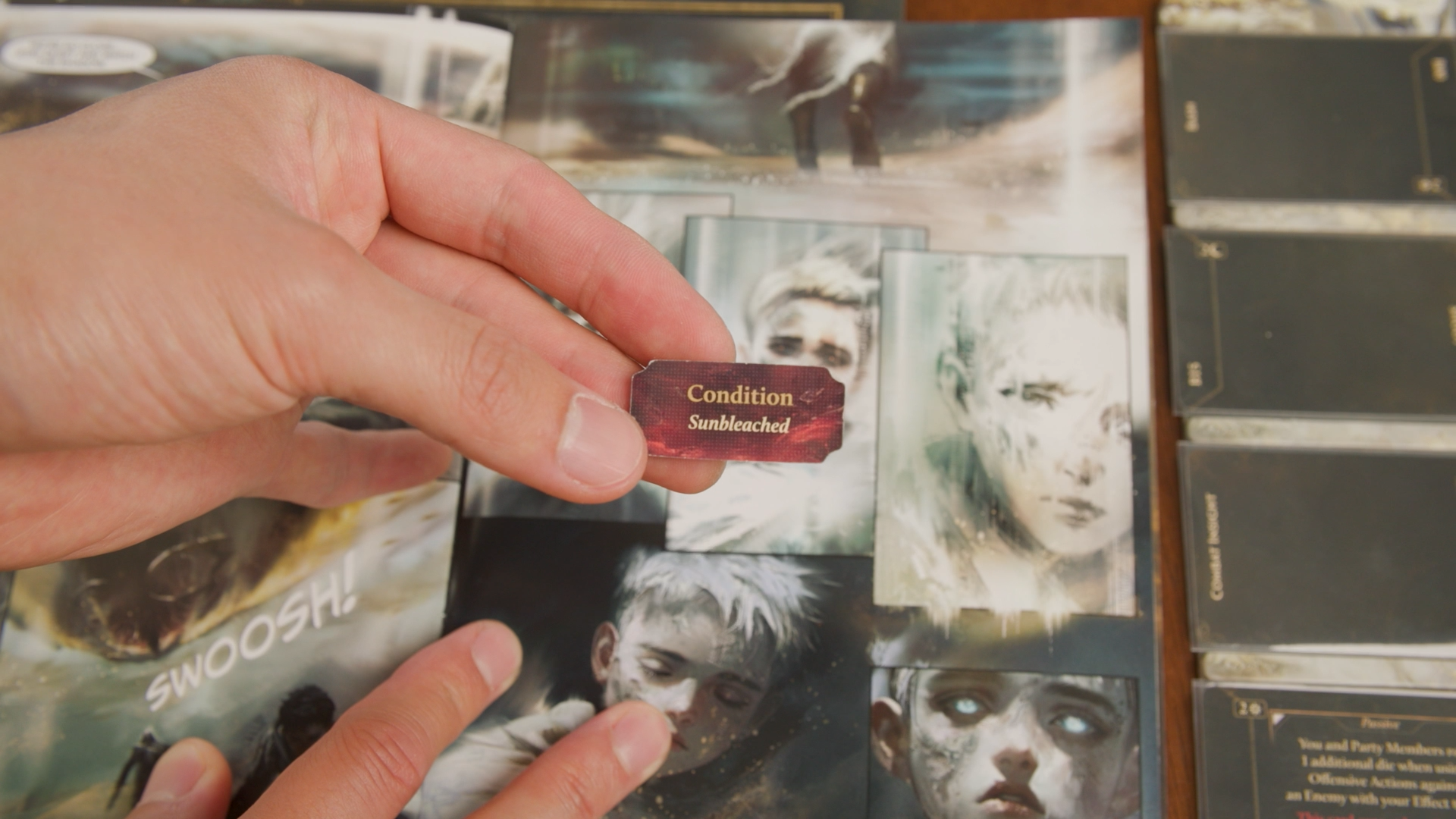
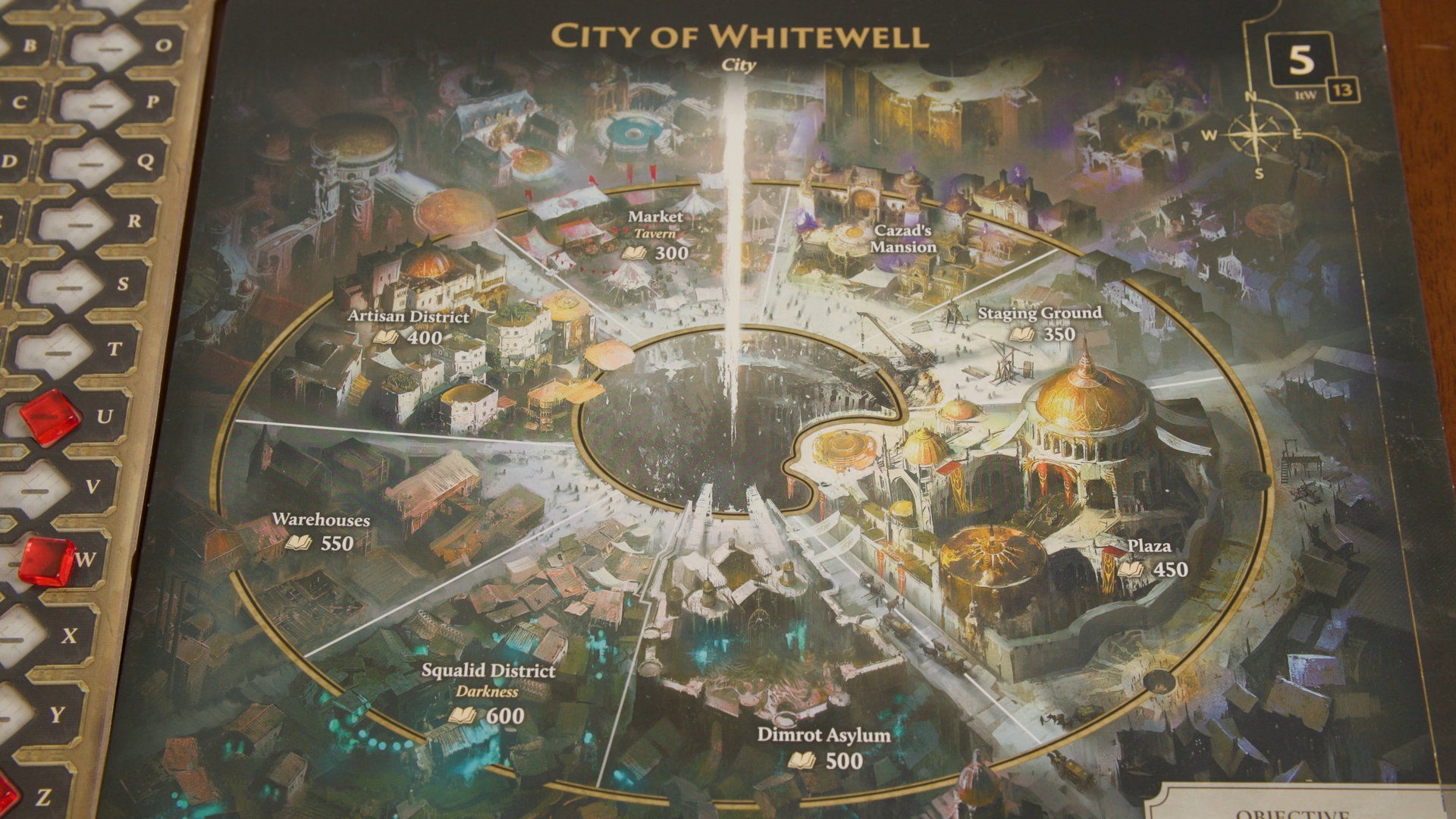
The dangerous sun affects exploration, cities, NPCs, and survival, and this is reflected in the mechanics.
Different regions feel distinct, especially when the game explores places outside the protection of the shield.
The main city design also reflects the setting, with power and wealth shaped by where sunlight can reach.
The writing in general has a sense of humor and does not become relentlessly grimdark.
Gameplay Pros - Excellent Character Customization
Players choose from multiple races, classes, class paths, origins, stats, equipment, keywords, and backstories.
The system uses keywords to simplify what could otherwise become overwhelming.
Pre-generated characters are available for groups that want to start faster.
Gameplay Pros - Checks and Fate
The dice system is one of the game’s best mechanical ideas. Players roll a number of D12s based on the relevant stat.
The fate symbol means a failed roll can still give players resources for later.
Players are encouraged to support each other because extra dice can mean more successes or more fate.
Fate can be spent on rerolls, and three fate can be spent for an extra combat action.
Getting fate when downed or revived helps avoid a miserable death spiral.
Double successes make big rolls exciting without needing extra storybook text.
Gameplay Pros - Starting From the Fiction
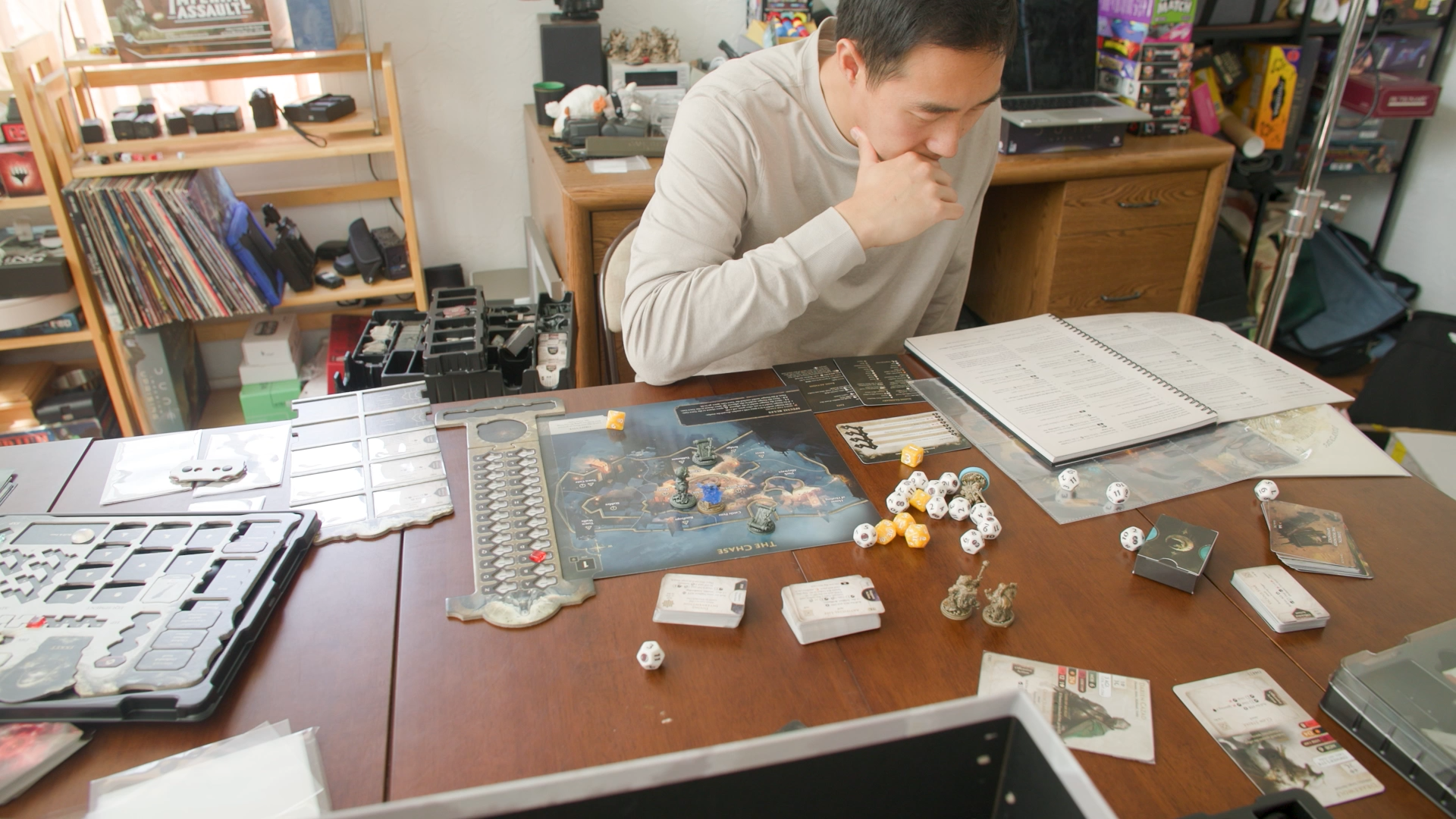
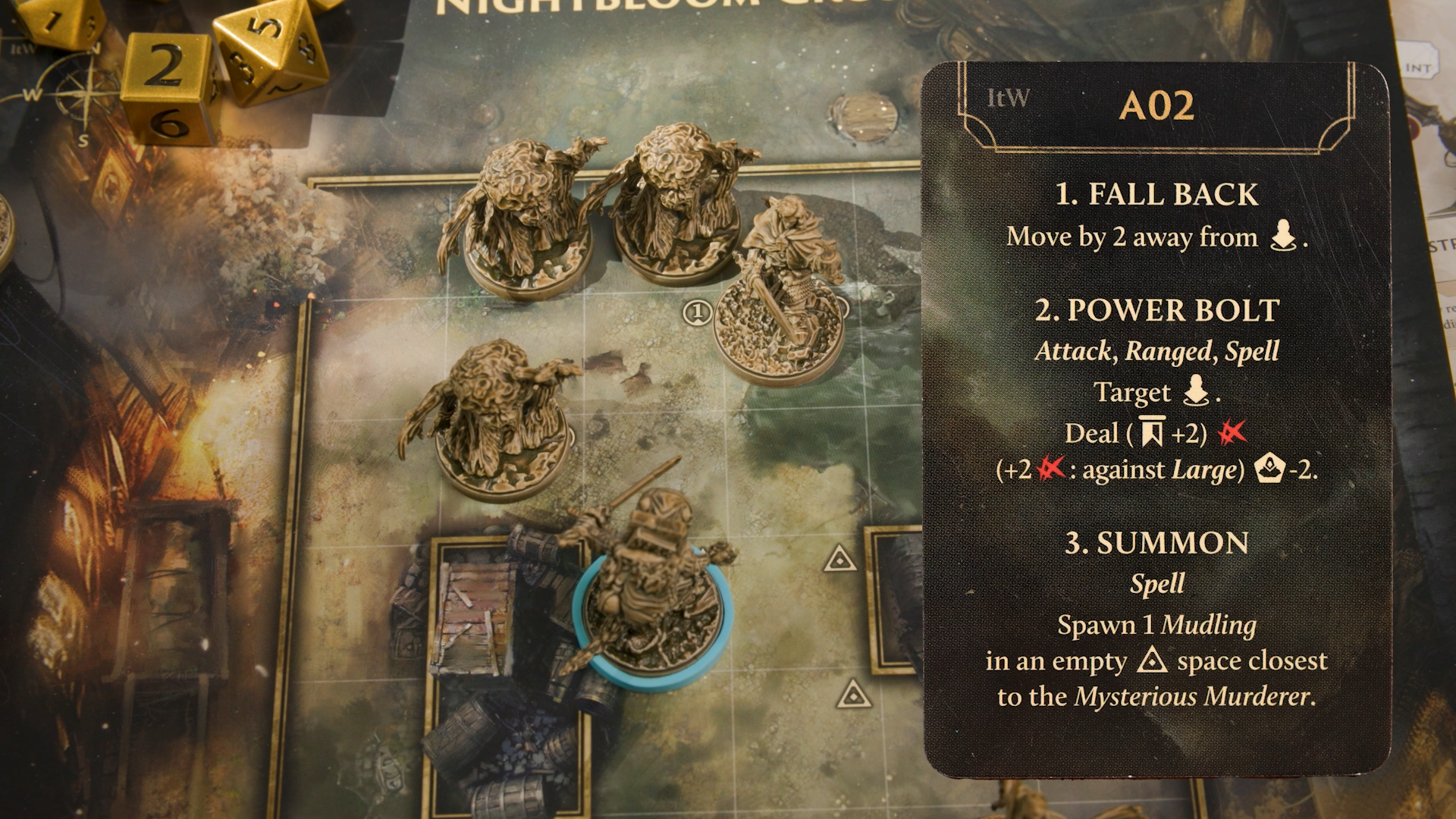
Combat is faster and smoother than expected for a game this large.
Fights usually have clear story buildup.
Battles are not random filler; they happen because of the story or player choices.
Some fights are avoidable, which helps when the party is weak or short on real-life time.
Setup is fast because the storybook tells you exactly what sheet, enemies, cards, and tokens to use.
Story choices can change combat setup, enemy placement, terrain, objectives, or available information.
Some enemies may have cards revealed if players gathered knowledge beforehand.
The game frequently ties combat objectives to story consequences, making battles feel meaningful.
Gameplay Pros - Clean Tactical Systems
Initiative is handled through a bag of black and white tokens.
Enemy and player turns come out unpredictably, but with very little bookkeeping.
There is no line-of-sight system, which keeps ranged attacks simple.
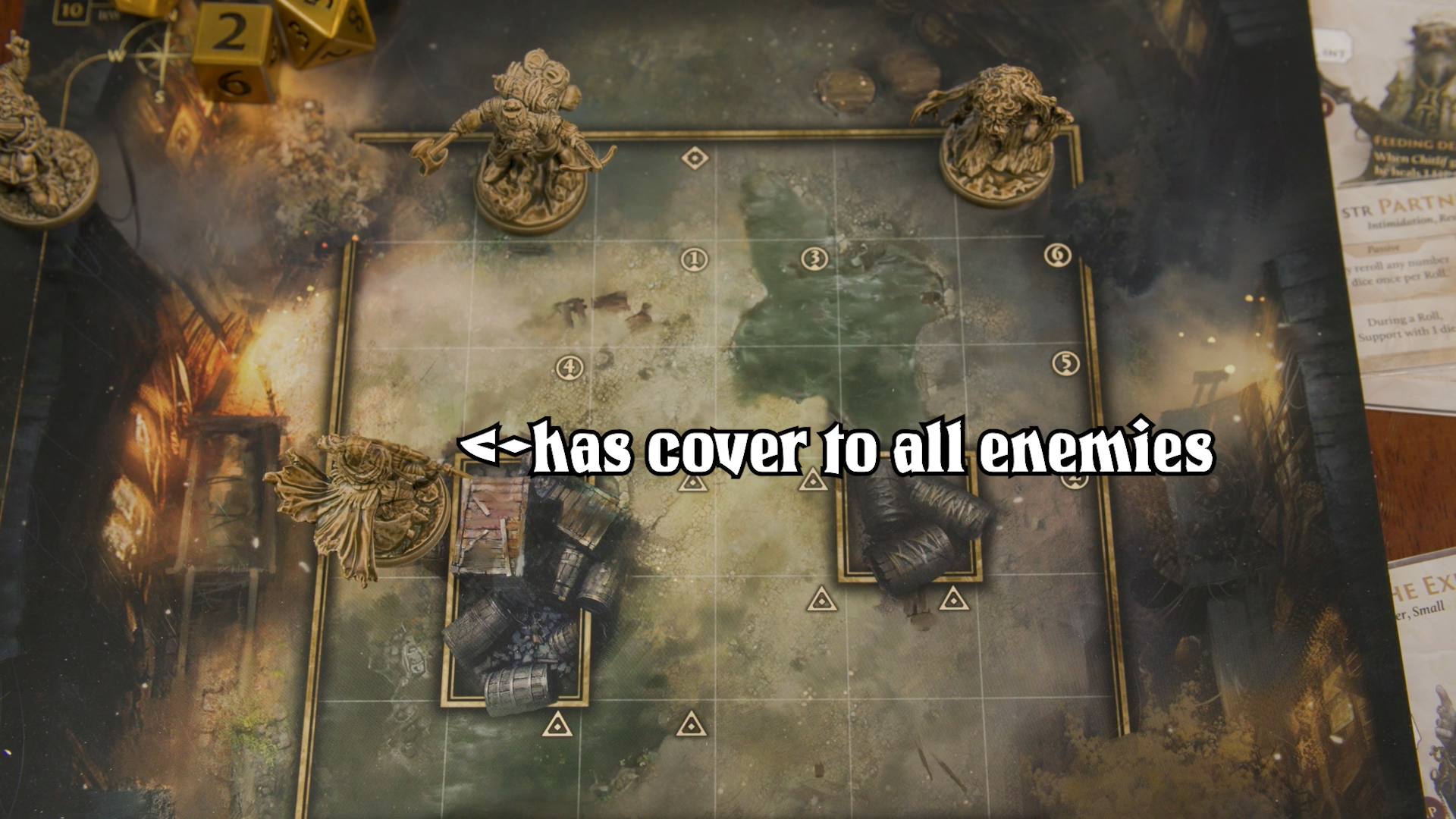
Cover simply adds armor.
Minions usually have one health, making them easy to manage.
Conditions mostly apply to elites and bosses, keeping the map cleaner.
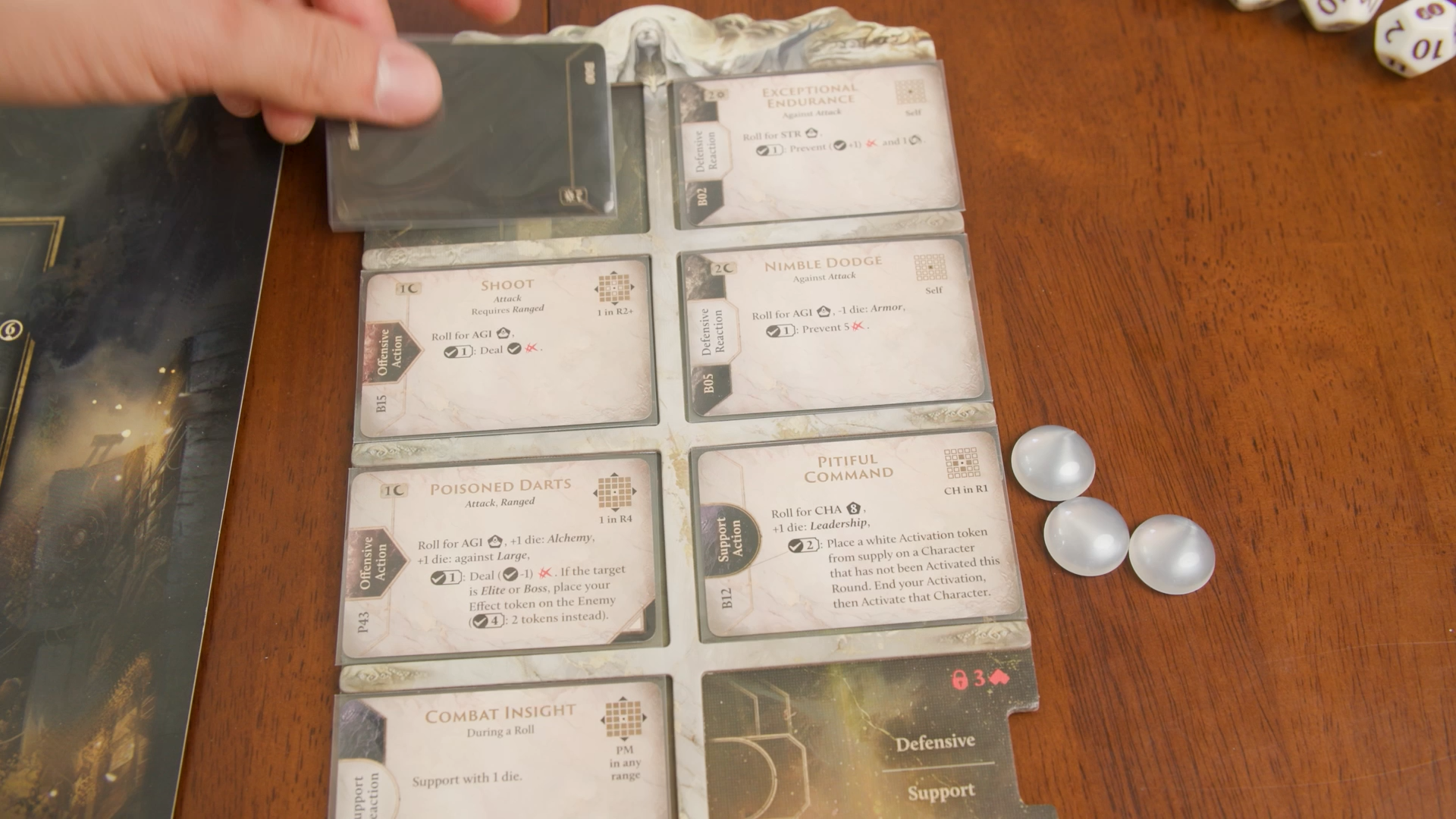
Character cards stay on the player board, so players do not need to manage a hand of cards.
Most fights are effectively boss fights or elite encounters, which keeps combat from feeling like filler.
Gameplay Pros - Story Moments Inside Combat
Combat maps often include special actions tied to the scenario.
Players might interact with terrain, use environmental features, trigger story passages, or unlock special reactions.
This makes combat feel like a real event in the world rather than a separate minigame.
The limited action economy makes these story actions tempting without overwhelming players.
Once-per-fight cards are smart because discarding them reduces decision space, but players must think about when they can rest to recover them.
Gameplay Pros - Companions and Progression
Companions are an excellent way to support solo or low-player-count games.
They simplify extra party members without requiring full player boards.
Companions can move, attack, support, trigger story logs, and use map-specific actions.
Camp lets players heal, upgrade, progress companions, and use character keywords.
Character advancement is satisfying because tokens quickly unlock stats, skills, or new cards.
Leveling avoids big RPG tables and excessive bookkeeping.
Items are expressive and often funny, giving players lots of ways to customize their character.
Gameplay Pros - Adventure 3 Payoffs
The combat variety continues all the way into Adventure 3. Even late in the campaign, fights keep introducing new mechanics and rarely feel like repeats.
EXP and item progression still feel well timed. Even after skipped or failed fights, character advancement feels like it arrives at satisfying points.
Higher Divinum becomes more rewarding in Adventure 3, giving late-game characters more reasons to care about that progression.
The Fate dice system continues to feel good even when the game escalates into much larger dice pools and harder checks.
Component Cons - Cardboard Woes
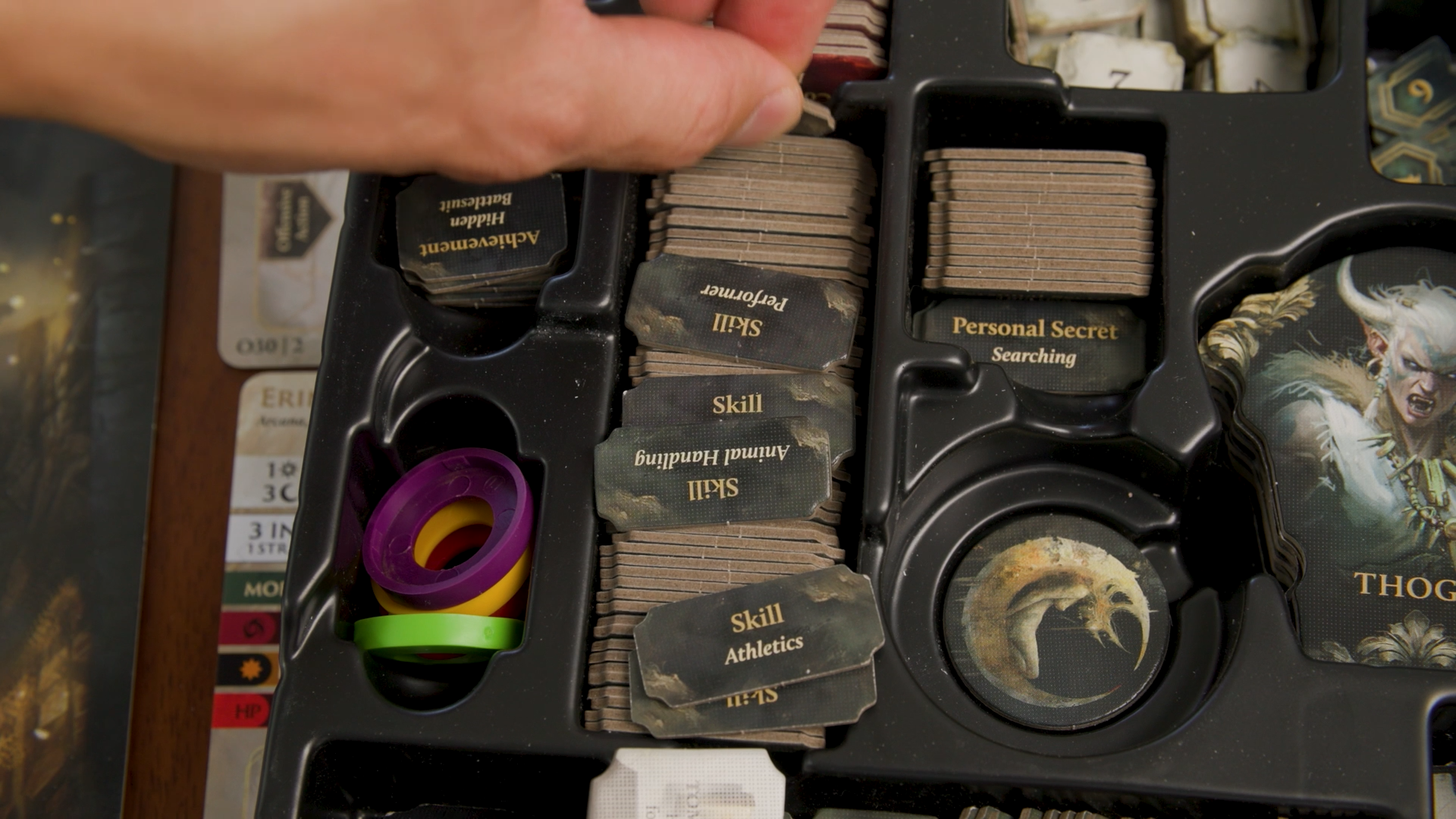
The game is impressively organized overall, but the item tokens are a major pain to search through.
There are so many item types, shapes, rarities, and colors that finding a specific item can slow down the excitement of earning it.
The insert seriously needs clearer labels, dividers, or a better sorting system.
Skill tokens have a similar issue, though they are less frustrating because there are fewer of them.
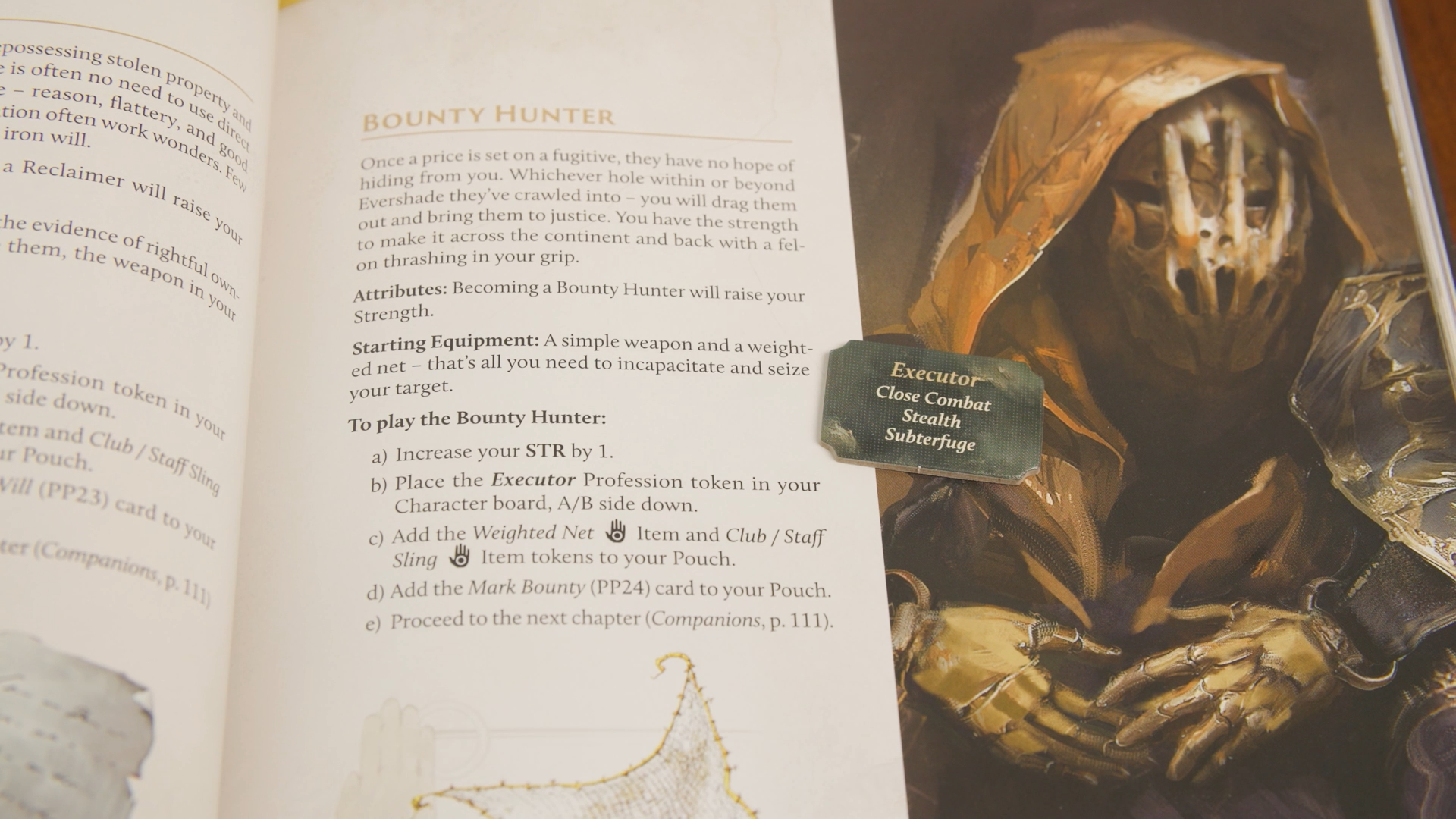
Some character creation tokens feel unnecessary because they are placed once and then rarely touched again.
Race, profession, origin, and personal secret tokens could probably have been tracked more simply.
The amount of cardboard adds to the game’s sense of scale, but also increases setup friction.
Component Cons - Usability and the Rulebook
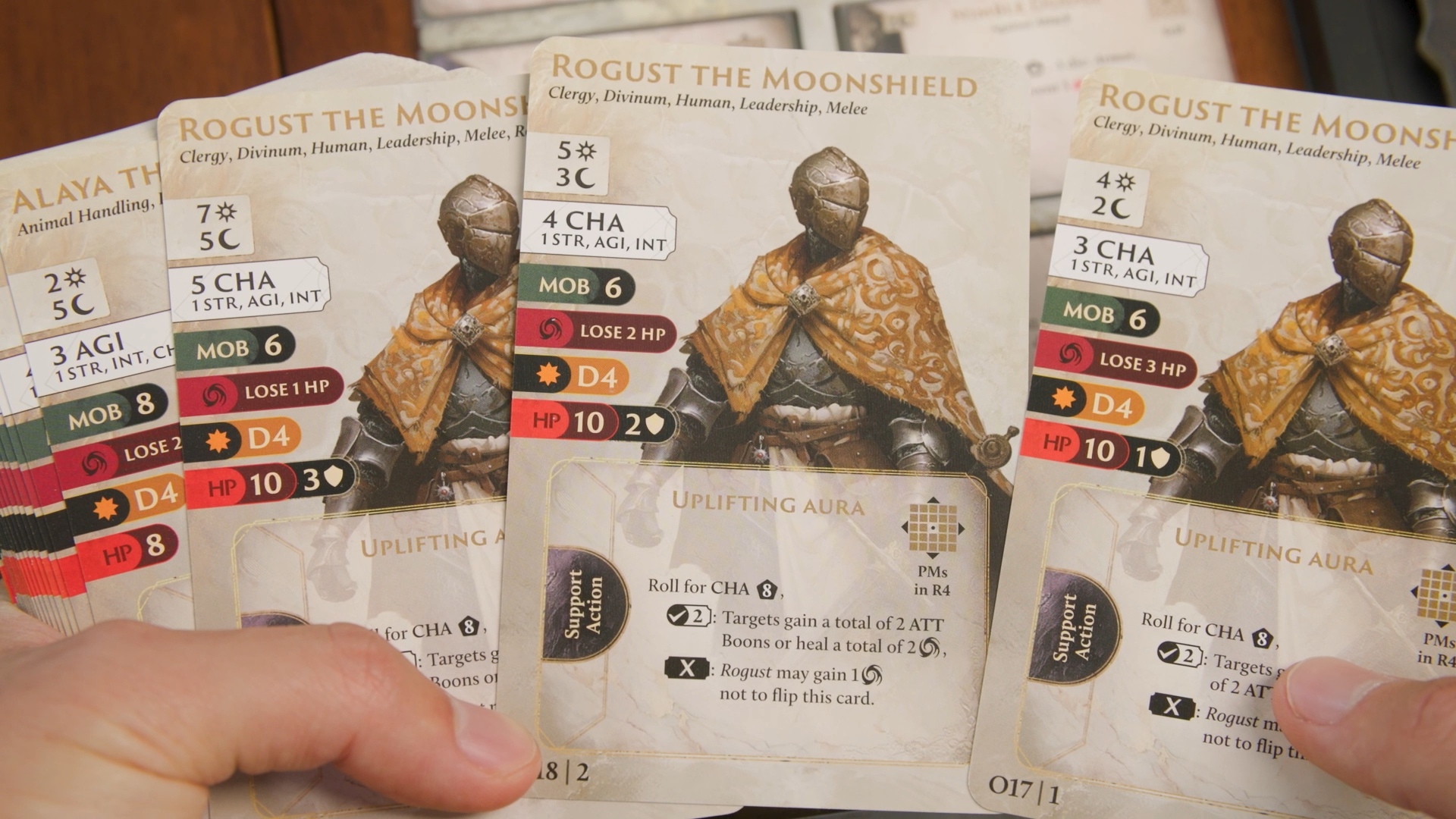
HP dials for companions and large enemies are too small and can shift accidentally.
Some icons, especially full-party versus half-party symbols, look too similar.
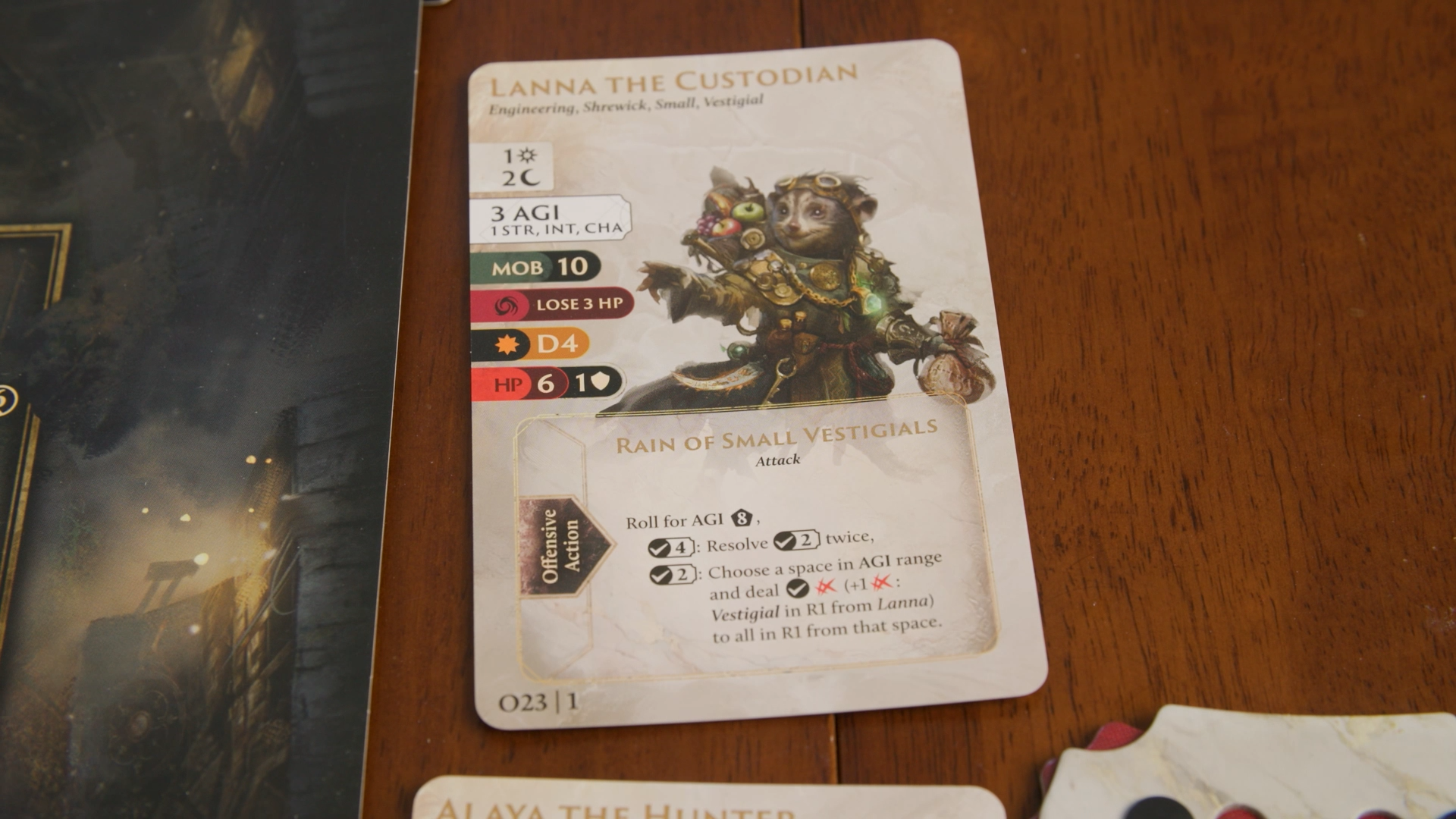
Upgraded companion cards are mechanically different but visually too similar to their earlier versions.
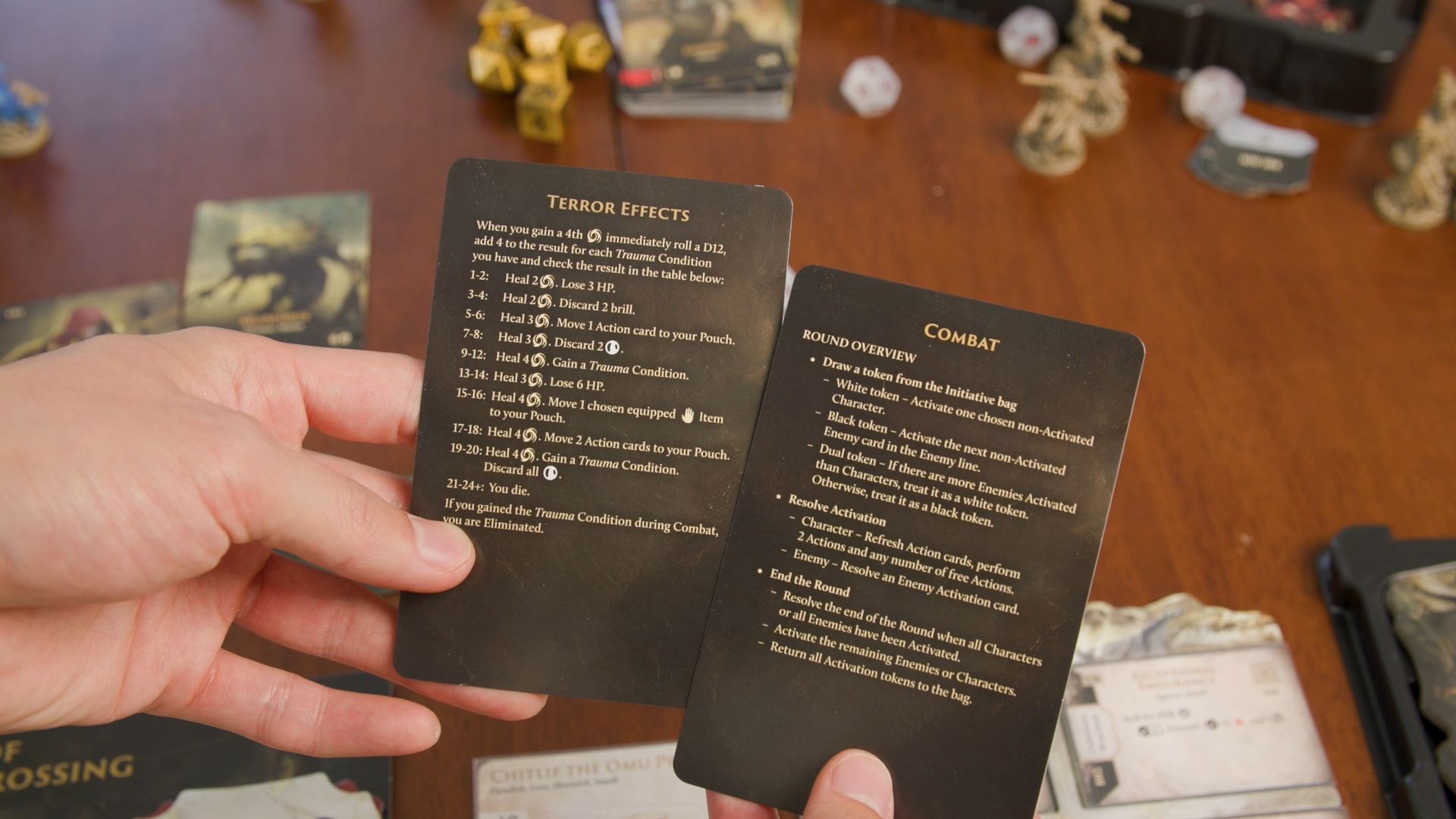
The game could use better companion, support, and cover reference cards.
The rulebook is better than some previous Awaken Realms rulebooks, but still has clarity issues.
Some combat rules need more visual examples earlier.
Knocked-out and eliminated rules are easy to miss.
The game badly needs a full glossary or separate reference booklet.
Gameplay Cons - Some Combat Weirdness
The simplified combat system is fast, but it creates some odd moments.
Cover can be easy to forget because there are no normal line-of-sight rules, yet cover still sometimes behaves like line of sight matters.
Enemy activation can occasionally feel swingy when bosses and minions go back-to-back.
These moments are not necessarily game-breaking, but they can feel rough.
Gameplay Cons - Progression Balance Questions
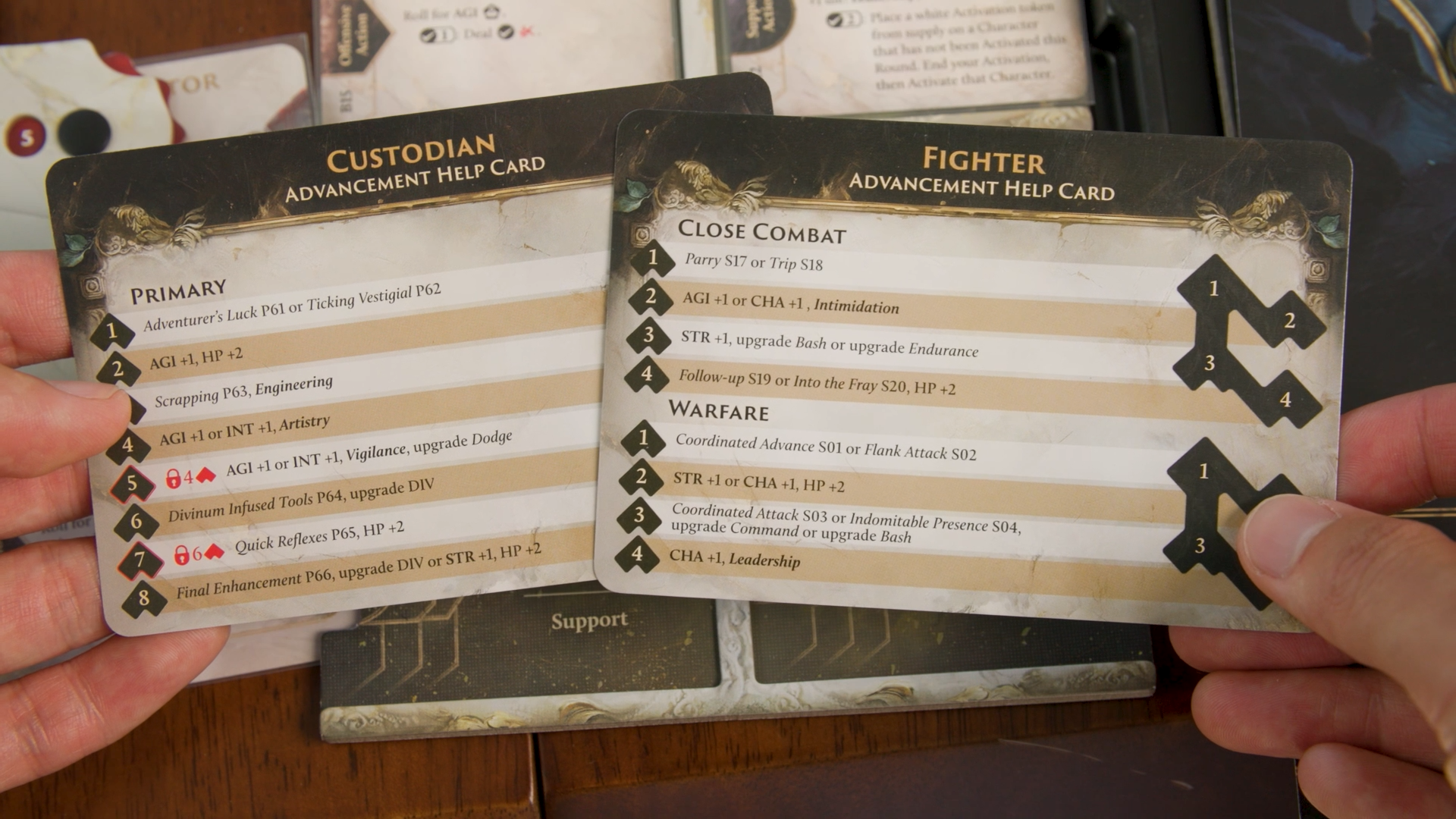
Some class upgrade paths overlap in ways that make certain advancement choices feel less exciting.
The game may reward focusing heavily on one stat, similar to some tabletop RPGs.
This is not a major issue for casual play, but min-maxing players may be able to push the system harder than intended.
Gameplay Cons - Player Count and Table Size
Two players feels like the sweet spot.
Solo works, but item distribution becomes awkward because companions cannot use equipment like full characters.
Five players may create too much downtime, table crowding, and component management.
Three or four players are probably fine.
The game already takes up a lot of space at two players, so larger groups will need a serious table.
Gameplay Cons - Story and Pacing Issues
Some story passages are worded awkwardly or require light handwaving.
Side paths can feel less polished than the main route.
A few story jumps happen too quickly, making certain events feel rushed.
Occasionally the game references factions, choices, or consequences in ways that may not fully line up with the path players actually took.
The personal secret mechanic is interesting on paper, but after two adventures it feels underused.
Secret moments can trigger suddenly, then disappear from the story for a long time.
This may pay off later, but so far it feels more like a tease than a fully developed system.
Gameplay Cons - Scenario Rough Edges
Some scenarios sound dramatic but do not fully pay off mechanically or narratively.
A few rescue or exploration scenes could have worked better as puzzles, fights, or cleaner skill-check sequences.
Some map symbols and objectives needed clearer wording.
A few combat scenarios can feel feast-or-famine, especially when environmental hazards can eliminate players early.
Gameplay Cons - Final Adventure Strain
The component issues do not fully go away, even once you are used to the game.
Adventure 3’s storybook gets noticeably wonkier, with more awkward wording, errors, and moments that feel under-polished.
Partners and companions feel underpowered late in the campaign, especially because they cannot equip items or defend themselves as well as full characters.
Solo play starts wasting a lot of item potential because only the main character can really benefit from the huge pile of equipment.
Some Adventure 3 overland sections feel weaker, shifting from meaningful exploration into broader, less interesting travel.
Recommender Score: 8/10, Great + Shelfside Certified
Now it is time for the recommender score for this giant game about hanging out in the shade, where we critically evaluate the pros and cons while also acknowledging that no review is completely unbiased.
After playing through two full adventures, which is roughly 36 hours of printed game time and around 24-plus hours of actual play for us, Lands of Evershade gets a recommender score of 8 out of 10. It is great. It also gets Shelfside Certified for doing genuinely cool new things in the tabletop RPG space, the campaign board game space, and even parts of the tactical battler and dungeon crawler space.
For fun, if this review had only been based on the first adventure, the score probably still would have been an 8 out of 10. I could even see it maybe being a 9 out of 10 if we had gone down a more ideal path, especially knowing some of the secret sheets and alternate possibilities. But that is also the nature of a choose-your-own-adventure game. Your experience is variable. Different groups will see different combats, spend different amounts of time with different NPCs, and follow different branches. And realistically, we were not going to replay a 15-hour adventure with another group just to compare every route. Once I played the second adventure, Ashes of Heaven, that really cemented the 8 out of 10 recommended score for me.
As the backer letter says, this hybrid RPG really does combine a lot of Awaken Realms DNA. It has some of the overworld feel and combat DNA of Dragon Eclipse. It has the storybook structure of Tainted Grail, especially closer to Kings of Ruin in how it is not fully open world. It also has the rest and upgrade phase energy of ISS Vanguard, except here it becomes a camp phase that feels more like hanging out with the party in Baldur’s Gate or Final Fantasy XV, setting up camp with all your Coleman gear (not sponsored).
The game is definitely a commitment to start. It took about two hours to unbox and properly store everything, and around an hour to make a character at the beginning. But once that work is done, there is no GM prep required. That is a huge deal for RPG groups, because as the saying goes, no one wants to DM.
Compared to normal tabletop roleplaying, you get the benefit of all this art and all these physical components. The game gives you things to touch, roll, flip, slot, move, and discover. The presentation does a lot of heavy lifting for immersion. The rolling system is also excellent, especially for a game that favors exploration and achievement over pure scarcity.
The game also feels like strong bang for your buck. For around $120 MSRP base game ($80 MSRP without minis, though shipping/taxes not included), you get the storybook, the core campaign experience, tons of art, a huge pile of items, character options, and more physical material than most board games would even attempt. The amount of item content alone is ridiculous. You can throw daggers, create smoke screens, wear useless items proudly because they came from a story moment, stack armor for keywords, or just hold onto things because maybe they will matter later in combat or on the overland.
Are all of those wild things explicitly perfect gameplay? Not always. But they are expansive and expressive, and that is probably what a lot of role players want. This game understands the appeal of character customization. It feels like the creative team played a lot of RPGs and threw in a bunch of ideas so players could create weird little stories through their character, item, and card combinations.
For combat, this is not a true tactics game in the deepest sense, even though it may look like one at first. The maps are small, range is heavily handwaved, and the focus is not meticulous min-maxing. It is more about hype moments, surprising twists, and reaching for the storybook during combat to see what happens next. The game is not trying to be Frosthaven. It is trying to make your ragtag fantasy party feel like it is inside a cinematic story encounter.
The game is absolutely gorgeous and often integrates components really well, but there is also jank. Some of that jank scales with the size of the game. There are so many components, so many cards, so many tokens, and so many systems that some rough edges are inevitable. Still, this could have been far jankier. If this had been Awaken Realms’ first board game, I imagine the component experience would have been much rougher. Instead, a lot of the game is surprisingly smooth.
That said, even with the glowing pros, we cannot rate this higher than an 8 out of 10 recommender score. As an idea, though, Lands of Evershade is brilliant. This system could be a golden goose for Awaken Realms if they keep releasing more adventures. They could even use the same core system in a completely different world, like a sci-fi setting with some mechanical tweaks.
Lands of Evershade is not just a massive home run swing that comfortably makes it to third base. It is an immense towering castle. And because it is a tremendous castle, it will inevitably have more problems than most retail board games, which are more like single-family houses by comparison. This hybrid RPG and board game asks a lot of itself. The combat and story are deeply connected, so both halves need to work smoothly together almost all the time; that is a tall task. If you have played enough campaign board games, you have probably seen scenarios where the flavor completely falls apart, but the mechanics are still fine enough that you keep going. From what I have seen, Lands of Evershade does not commit that crime.
Get this if it looks like your kind of game and you have a lot of time to spare. It is big, immersive, story-focused, mechanically simple in the right places, and still full of meaningful choices. Ultimately, it is not too complicated. You can sit around, chuck dice, laugh about stupid decisions with your friends, and feel like you are playing through a fantasy RPG campaign without needing a GM. It is also much easier to get into if someone else owns the game and manages the components. In that sense, even though the game has no GM, the game owner still sort of becomes the GM by handling the physical overhead.
If we think about traditional Dungeons & Dragons-style fantasy, Lands of Evershade also benefits from Awaken Realms straying from some of their usual grimdark fantasy writing. The first adventure is a little more familiar and fantasygeneric, with some Game of Thrones-style political intrigue and enough Evershade-specific ideas to give it flavor. It could almost work as an introductory D&D campaign, which is probably perfect for the target audience. Do not skip the first adventure, though, because Adventure 2 being labeled “advanced” really means advanced. I cannot imagine jumping into it without already knowing the rules. But that is also where the world starts to take off like a giant faderay rising into the sky.
If you are newer to board games, or you do not play board games often but this looks amazing to you, the game is surprisingly approachable as long as someone helps manage the components. The early handholding is strong, and the forgiving nature of the system makes it easier to choose silly options without feeling like the margin for error is too thin. If you want deeper combat and murder-hobo dungeon crawling is your main priority, you may want something like Imperial Assault or Frosthaven instead. If you want silly thematic mystery without this much setup, Mansions of Madness: Second Edition may scratch a somewhat similar itch. If you want harder political intrigue and stronger worldbuilding prose, Tainted Grail: Kings of Ruin, at least from the early chapters, has better writing. But it does not have Lands of Evershade’s bigger and better combat system.
After playing one or two Awaken Realms games every year for the past few years, I am still impressed by how often they push the envelope of board games. They find strong market fit and then actually bring these giant ideas to life. I am sure the idea of a huge RPG board game has crossed many publishers’ minds but very few companies have the resources, artists, production pipeline, and ambition to pull off something this large. Descent 1st Edition, HeroQuest, and the DnD Adventure board game line like Castle Ravenloft are early examples of this, though they’re not even close in size to Lands of Evershade. And the game mostly works excellently. It is big and bumpy, but you can get to the end of adventures without too much frustration. With a cleaned-up second edition, better component handling, and some story passage revisions, Lands of Evershade could very easily become a future 10/10 masterpiece.
Post-Final Adventure Thoughts:
After completing all three adventures, the score remains unchanged: 8/10 recommended score, 8/10 personal score, and still Shelfside Certified.
Adventure 3 does not ruin the game, but it does make the idea of an easy 10/10 second edition feel less likely. The first adventure feels like the most polished and carefully scoped part of the box, while the later adventures become more ambitious, more epic, and also more uneven.
That said, Lands of Evershade is still a strong value, especially if you play with two to three players and really take your time with Adventure 1. The quality does not strictly go up from there, but the game still delivers some incredible boss fights. Even after the frustrations, several Lands of Evershade fights will probably remain among my best gaming moments of 2026.
The future epic adventure is hard to judge, especially because by the end of the core box, character progression already feels close to maxed out.
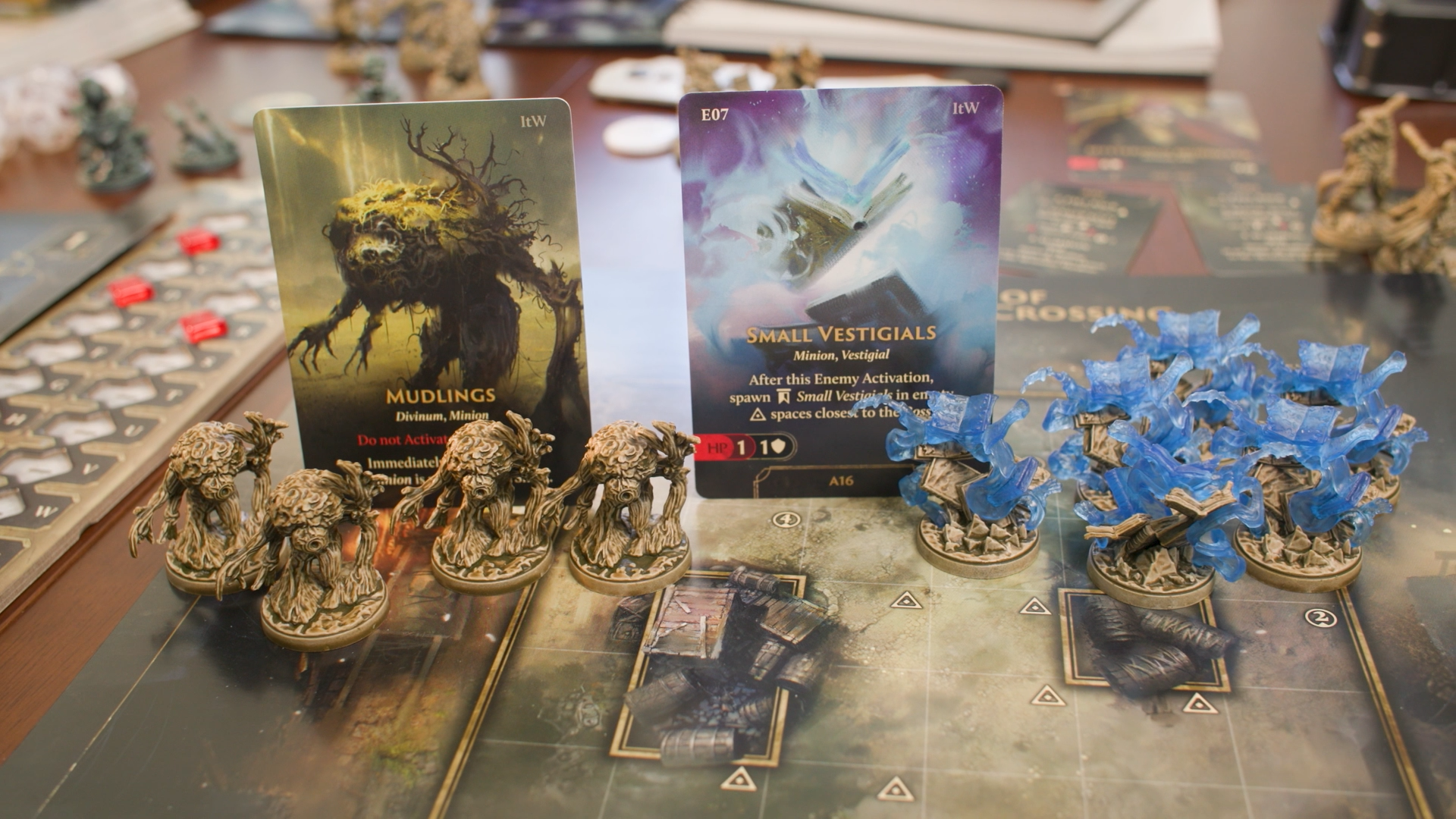
A bang-for-buck, towering fantasy achievement, filled with no shortage of CYOA DnD-inspired story moments for your entire party, whether in the streamlined combat or not. The declining quality of adventures may not matter to many, but completionists will wonder if three 18-hour boxes was a little too rushed in development.
Recommender Score

Daniel’s Personal Score

Ashton’s Personal Score